
A print shop workflow bottleneck is any single production stage that moves slower than every other stage, forcing jobs to pile up and wait. That one slow step sets the speed limit for your entire shop. Whether the constraint sits in prepress, on the press floor, or in finishing, it controls your throughput whether you recognize it or not. Tools like Enfocus Switch, Callas pdfToolbox Server, and production platforms from Heidelberg and HP have made press operations faster than ever. The real problem is that finishing and post-press processes have not kept pace, and most managers are still looking in the wrong place.
What is a print shop workflow bottleneck?
A print shop workflow bottleneck is defined as the one stage in a production sequence that limits the output rate of the entire system. The term comes from the Theory of Constraints, developed by Eliyahu Goldratt, which holds that every system has exactly one weakest link at any given time. In print production, that weakest link is almost never where managers expect it to be.
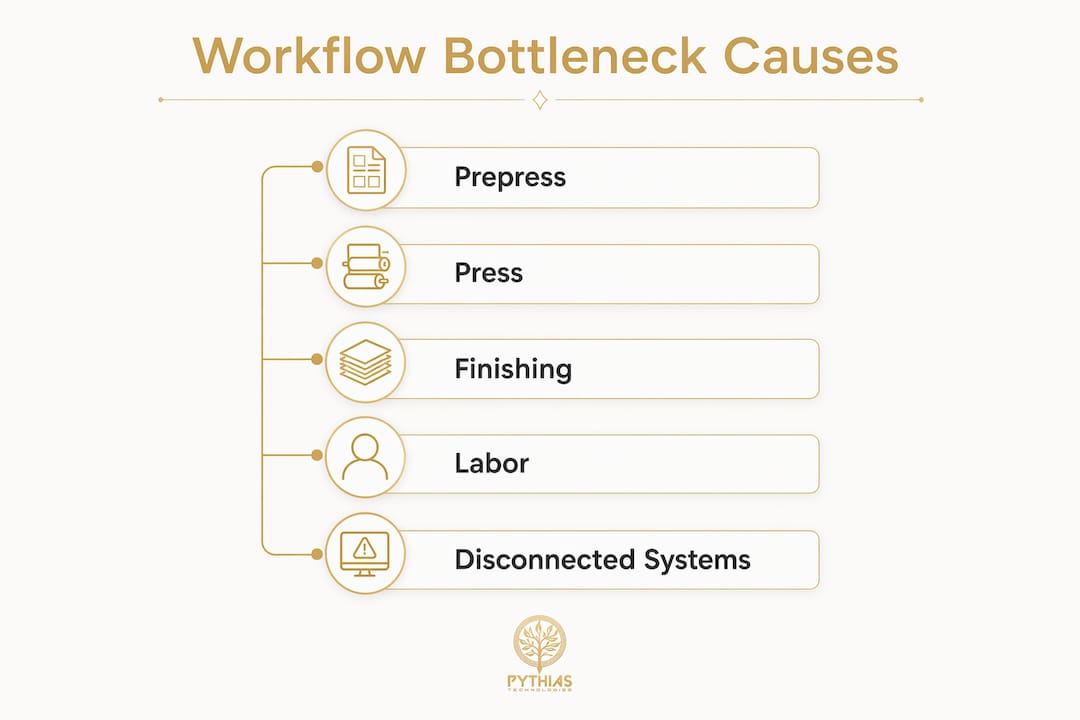
Production moves through distinct stages: prepress (file intake, preflight, imposition), press (makeready, printing), and finishing (cutting, binding, laminating, kitting, packing, and shipping). Each stage hands off to the next. When one stage processes jobs slower than the stage feeding it, work accumulates in a queue. That queue is the visible sign of a bottleneck. The constraint does not have to be a machine. It can be a manual approval step, a single operator, or a disconnected data handoff between systems.
Print shop efficiency issues compound quickly because a bottleneck in one area creates idle time everywhere else. Presses wait for prepress to release files. Finishing waits for press output. Shipping waits for finishing. The entire shop runs at the speed of its slowest step.
What are the most common types of bottlenecks in print shop workflows?
Bottlenecks in the printing process fall into three main categories: prepress, press, and finishing. Each has distinct causes and distinct impacts on throughput.
| Bottleneck Type | Common Causes | Typical Impact |
|---|---|---|
| Prepress | Manual file intake, approval delays, preflight errors | Jobs stall before printing begins |
| Press | Long makeready, unplanned maintenance, job changeovers | Press sits idle; schedule slips |
| Finishing | Manual stacking, binding, kitting; labor shortages | Output piles up; shipping delays |
| Logistics/Shipping | Disconnected systems, manual label generation | Orders miss carrier cutoffs |
Prepress bottlenecks are caused by chaotic file intake and slow customer approval cycles. When operators manually check every file for resolution, color profiles, and bleed settings, errors slip through and jobs bounce back for correction. Automating preflight and imposition can reduce prepress touch time by 60–80%, which is a significant recovery of productive time.
Press bottlenecks are most visible during makeready. Every job changeover on an offset or digital press consumes time that produces nothing. Unplanned maintenance compounds the problem because it is unscheduled and unpredictable.
Finishing bottlenecks are the most underestimated. Cutting, laminating, binding, and packing lines frequently run at a fraction of press output speed. The result is a growing stack of printed sheets waiting for post-press processing.
Pro Tip: Automate your prepress intake first. Tools like Enfocus Switch use hot-folder workflows to route, preflight, and impose files without operator intervention. Removing manual steps at the front of the queue prevents delays from compounding downstream.
Why is finishing often the primary bottleneck in modern print shops?
Finishing has overtaken the press as the dominant constraint in most production environments. 83% of production inkjet operators identify finishing, not printing, as the primary limit on their throughput. That number reflects a structural shift in how print shops are built and staffed.
Press technology from vendors like Heidelberg, Xerox, and Canon has advanced rapidly. High-speed digital and offset presses regularly outpace the manual bindery, cutting, and packing lines that follow them. The result is a shop that is press-heavy but finishing-poor, where the most expensive equipment sits waiting for downstream processes to catch up.
“Finishing has setup time and labor needs similar to press makeready. Most shops track press utilization obsessively but never measure finishing throughput at all.” — PIWorld Research
Labor availability makes the problem worse. 43% of providers cite labor as a direct constraint on finishing capacity. Stacking, palletizing, and packing remain manual for 82% of providers, with only 13% running fully automated finishing workflows. That gap between press speed and finishing capacity is where most shops lose their throughput gains.
Disconnected workflows compound the issue further. When press output data does not flow automatically into finishing scheduling, operators make decisions based on guesswork. Islands of automation cause bottlenecks to shift downstream rather than disappear. A shop can automate prepress completely and still watch jobs pile up at the laminator because no one scheduled finishing capacity around actual press output.
How to identify and diagnose workflow bottlenecks in your print shop
Identifying a bottleneck requires measurement, not observation alone. The most reliable signal is a growing queue. Any stage where jobs consistently accumulate is either the bottleneck or is feeding directly into one.
Track these metrics at every production stage:
- Wait time vs. touch time. A job may require 20 minutes of active work but sit idle for hours between steps. Wait time typically exceeds touch time at a ratio of 3:1 to 10:1 in most print shops. Reducing idle queue time delivers more throughput than speeding up any single machine.
- Queue length at each stage. Count jobs waiting at prepress, press, and finishing at the same time each day. The stage with the longest queue is your constraint.
- Utilization rate. A stage running at 95% utilization while others run at 60% is the bottleneck. High utilization at one point and idle time at others confirms the location.
- Stage idle time. Track how often each machine or workstation sits waiting for input. Idle time upstream of a bottleneck is normal. Idle time downstream signals the bottleneck is feeding too slowly.
JDF/JMF connectivity and MIS/ERP integration give managers real-time job status across every stage. Real-time job tracking removes the guesswork from queue management and makes bottleneck location visible on a dashboard rather than discoverable only through a shop floor walk.
Pro Tip: Set WIP limits at each major production stage. Limiting active jobs in the queue normalizes throughput and prevents operators from starting new work that will only pile up behind the constraint.
What practical strategies can resolve print shop workflow bottlenecks?
Resolving a bottleneck requires a specific response matched to its cause. Generic speed improvements rarely work because they often increase output at non-bottleneck stages, which only grows the queue at the actual constraint.
- Schedule everything around the bottleneck. Feed the bottleneck at maximum capacity and plan all other operations around its pace. Running the press faster than finishing can process is counterproductive. It builds WIP and creates errors.
- Automate prepress with hot-folder workflows. Enfocus Switch routes files automatically from intake through preflight and imposition. Callas pdfToolbox Server handles automated PDF correction and normalization. Both tools remove manual operator steps that create prepress delays.
- Batch jobs to reduce makeready time. Group similar substrates, ink sets, and sizes into production batches. Each changeover avoided is direct throughput recovered.
- Invest in finishing automation. Automated cutters, folder-gluers, and robotic palletizers directly address the labor and speed gap in post-press. The comparison below shows the throughput difference.
- Integrate MIS/ERP with finishing equipment. Connected data flows prevent the scheduling gaps that cause finishing queues to grow undetected.
- Use WIP limits to control flow. Cap the number of active jobs at each stage. This forces the shop to finish work before starting new work, which reduces errors and late jobs.
| Finishing Approach | Throughput Impact | Labor Dependency |
|---|---|---|
| Fully manual | Lowest; limited by operator speed | High |
| Partially automated | Moderate; bottlenecks shift to manual steps | Medium |
| Fully automated | Highest; consistent and predictable | Low |
Print station automation is the fastest path to closing the gap between press output and finishing capacity. Platforms like Pythias Fulfillment Cloud connect production scheduling, job tracking, and shipping into a single system, which eliminates the data silos that cause bottlenecks to move rather than disappear.
Investing in faster presses without aligning finishing capacity neutralizes throughput gains and creates WIP backlogs. The press is rarely the constraint. Finishing capacity, scheduling discipline, and data integration are the real levers.
How to sustain workflow improvements and avoid future bottlenecks
Fixing a bottleneck once is not enough. Production volumes change, product mixes shift, and new constraints emerge as old ones are resolved. Sustained improvement requires ongoing monitoring and management discipline.
Practices that protect workflow gains over time:
- Track KPIs weekly. Monitor queue lengths, wait times, and utilization rates at every stage. A rising queue at any point signals a new constraint forming.
- Hold cross-department scheduling reviews. Prepress, press, and finishing managers need to share capacity data regularly. Information silos rebuild bottlenecks faster than any equipment failure.
- Train operators on automated tools. Automation only works when operators understand how to configure, monitor, and troubleshoot it. Untrained staff revert to manual workarounds that defeat the system.
- Plan capacity upgrades before volume grows. Adding a new sales channel or product line increases order volume. Finishing capacity must scale before the press queue backs up, not after.
- Treat the bottleneck as the master of your schedule. Scheduling flow around the bottleneck and limiting WIP are the two most reliable practices for maintaining production reliability as volume grows.
Leadership sets the standard here. Shops that hit deadlines consistently have managers who review workflow data daily and adjust schedules before queues grow out of control.
Key Takeaways
A print shop workflow bottleneck is always the slowest stage in production, and finishing is the primary constraint in most modern shops.
| Point | Details |
|---|---|
| Finishing is the main constraint | 83% of inkjet operators identify finishing, not the press, as the primary throughput limit. |
| Wait time exceeds touch time | Jobs sit idle at a 3:1 to 10:1 ratio versus active processing time; reducing queue wait drives more gains than speeding up machines. |
| Schedule around the bottleneck | Feed the constraint at full capacity and plan all other stages around its pace to prevent WIP pileups. |
| Automate prepress early | Tools like Enfocus Switch and Callas pdfToolbox Server cut prepress touch time by up to 80%, preventing upstream delays. |
| Integration eliminates data silos | Connected MIS/ERP and JDF/JMF data flows stop bottlenecks from shifting downstream after partial automation. |
The bottleneck is never where you think it is
Print shops have spent decades measuring press utilization as the primary indicator of production health. I understand why. The press is the most expensive asset on the floor, and it is easy to watch. But after years of working with production environments, I am convinced that press-centric thinking is the single most common reason shops fail to hit deadlines.
The finishing floor is where throughput actually lives or dies. Shops that invest in a new digital press and then wonder why output did not improve are almost always running into a laminator, a cutter, or a packing table that cannot keep up. The press ran faster. The bottleneck just moved downstream and became invisible again.
The discipline that actually works is treating the bottleneck as the master of the schedule. That means running other equipment below capacity when necessary. It means saying no to starting new jobs when the finishing queue is already full. Most managers find that counterintuitive. It feels like wasted capacity. It is actually the only way to maintain flow.
Automation and real-time visibility tools make this discipline easier to maintain. When you can see queue lengths and utilization rates across every stage on a single dashboard, the bottleneck becomes obvious. The hard part is acting on what you see rather than defaulting to the old habit of pushing more through the press.
— Michael Thero
How Pythias Technologies addresses print shop workflow constraints

Print shops running disconnected systems will keep finding new bottlenecks after fixing old ones. Pythias Technologies built Pythias Fulfillment Cloud to connect production scheduling, job tracking, inventory management, barcode scanning, and shipping label generation into one platform. Managers get real-time visibility across every production stage, from order intake through finishing and dispatch. Pythias Commerce Cloud extends that visibility to multi-channel order intake from Shopify, Etsy, Amazon, Walmart, and TikTok Shop, so order volume never arrives as a surprise. For shops ready to move from reactive firefighting to scheduled, data-driven production, Pythias Fulfillment Cloud is built for exactly that transition. Book a demo to see how it fits your operation.
FAQ
What is a print shop workflow bottleneck?
A print shop workflow bottleneck is the single production stage that processes jobs slower than every other stage, limiting total throughput. All other stages must wait for it, regardless of their own speed.
Where do bottlenecks most commonly occur in print production?
Finishing is the most common bottleneck in modern print shops. Research shows 83% of production inkjet operators identify finishing as their primary throughput constraint, not the press.
How do I find the bottleneck in my print shop?
Track queue lengths and wait times at each production stage. The stage with the longest, most consistent queue is the bottleneck. A 3:1 to 10:1 ratio of wait time to touch time confirms where jobs are stalling.
How do WIP limits help with print shop efficiency issues?
WIP limits cap the number of active jobs at each stage, which prevents work from piling up behind the bottleneck. Limiting active jobs normalizes throughput and reduces errors caused by rushed handoffs.
Can software resolve bottlenecks in the printing process?
Software with JDF/JMF connectivity, real-time dashboards, and MIS/ERP integration makes bottlenecks visible and manageable. Platforms like Pythias Fulfillment Cloud automate scheduling and job tracking to prevent data silos from creating new constraints.
Recommended
- Print Shop Capacity Planning: What Managers Must Know | Pythias Technologies
- Optimize Your Garment Printing Shipping Workflow | Pythias Technologies | Pythias Technologies
- DTG Printing Order Management for Print Shops in 2026 | Pythias Technologies | Pythias Technologies
- How Rush Order Management Works for Print Shops | Pythias Technologies