

Most print-on-demand businesses rely on end-of-day production reports to track order progress. That approach feels manageable until a DTF job stalls mid-queue, a deadline slips past unnoticed, and your Etsy seller metrics take a penalty that takes weeks to recover from. Understanding why real-time job status matters is not a theoretical exercise. It is the difference between catching a problem at 10 a.m. and discovering it at 5 p.m. after the damage is done. This article covers how live status tracking transforms production efficiency, protects marketplace deadlines, and builds measurable competitive advantages for PoD operations.
Table of Contents
- Key Takeaways
- Why real-time job status matters: monitoring vs. reporting
- Deadline management and customer satisfaction
- Operational efficiency from live status data
- Best practices for real-time status implementation
- Financial and competitive gains from real-time capability
- My perspective on real-time job status in PoD
- How Pythiastechnologies supports real-time PoD production
- FAQ
Key Takeaways
| Point | Details |
|---|---|
| Real-time vs. batch reporting | Live status updates collapse feedback loops from 24 hours to under 60 seconds, enabling fast corrective action. |
| Marketplace deadline protection | Detecting a stalled job three days before an Etsy Dispatch By date prevents seller penalties and lost rankings. |
| Operational error reduction | Automated real-time status sync eliminates manual re-entry, reducing contradictory records and coordination overhead. |
| Financial performance link | Firms with strong real-time decision-making capability report meaningfully higher revenue growth and net margins. |
| Implementation discipline | Task-level status updates with synchronized shared states outperform coarse start/success/failure labels every time. |
Why real-time job status matters: monitoring vs. reporting
Most production teams conflate reporting with monitoring. They are not the same thing, and the distinction is where most PoD efficiency problems begin.
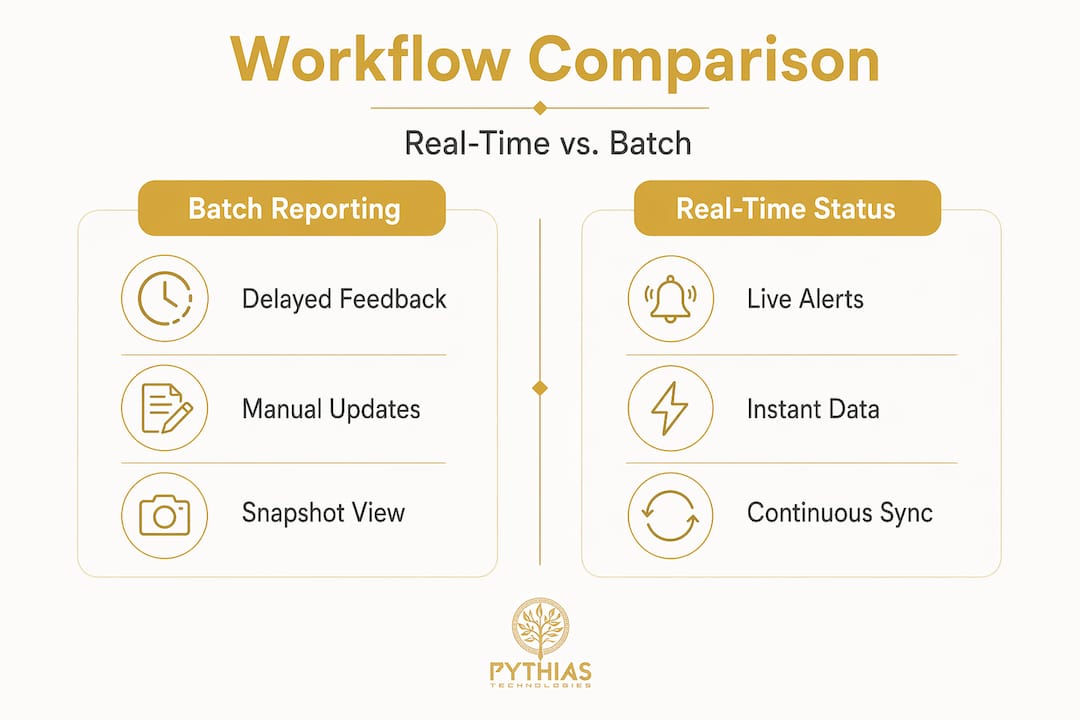
Reporting captures what happened. It pulls data at fixed intervals, batches it, and delivers a snapshot. A report showing 94% of yesterday’s orders completed sounds healthy right up until you realize the 6% includes three orders with Dispatch By dates tomorrow.
Monitoring, by contrast, tracks state continuously. Real-time OEE dashboards update machine state every two seconds and recalculate full metrics every 30 seconds, collapsing the feedback loop from 24 hours to under 60 seconds. That 60-second window is where corrective action becomes possible.
In a PoD production floor context, real-time job status means every order in your queue carries a continuously refreshed state. That includes:
- Current production stage (submitted, printing, QC, packaging, shipped)
- Time elapsed in the current stage versus expected SLA
- Alerts triggered when a job exceeds its stage threshold
- Supplier handoff confirmations timestamped as they occur
The critical insight here is that a dashboard read after an issue has already developed is reporting, not monitoring. True real-time status requires a live corrective-action window, not just a prettier report delivered faster.
Pro Tip: Set stage-level SLA thresholds in your production queue, not just order-level deadlines. An embroidery job stuck in “submitted” for four hours is a problem. An order labeled “in production” with no sub-stage visibility gives you nothing to act on.
Deadline management and customer satisfaction
Marketplace deadline pressure is one of the most concrete reasons PoD managers need live job visibility. Etsy calculates its Dispatch By date from your store settings, and it does not care that your DTF supplier had a machine outage on Tuesday.
Early detection of stalled jobs approximately three days before a Dispatch By date is the threshold that enables meaningful intervention. After that window closes, your options narrow to expedited shipping, customer communication, or absorbing a seller penalty. None of those are good outcomes.
Here is how real-time status visibility changes that sequence:
- Job enters the queue. The system records submission time and calculates the expected production completion against your Dispatch By date.
- Stage timers run. If a job passes its stage SLA without progressing, an alert fires to the responsible team member.
- Early warning at 72 hours. Jobs approaching deadline without reaching the packaging stage trigger escalation protocols.
- Proactive customer communication. The operations team contacts the buyer before the deadline passes, preserving trust and offering options.
- Post-incident review. Timestamps on each stage identify whether the delay originated with the supplier, the file prep step, or the shipping handoff.
Without that sequence, the first signal of a problem is often a customer complaint or a marketplace notification. At that point, you are managing damage, not preventing it.
Pro Tip: Build a filtered view in your production queue that shows only jobs within 72 hours of their Dispatch By date and not yet in a “shipped” state. Review this view twice daily. It takes two minutes and catches most deadline risks before they become penalties.
Customer satisfaction in PoD scales directly with delivery predictability. Buyers do not expect perfection. They expect communication. Real-time status gives your team the data to communicate proactively, and that single capability often matters more to repeat purchase rates than price.
Operational efficiency from live status data
The internal efficiency gains from real-time job tracking are just as significant as the customer-facing benefits, and they tend to compound faster.

Eliminating manual coordination overhead
When job status lives in a spreadsheet or an end-of-day report, every team member operates on a slightly different version of reality. A packing team that does not know a DTF print is still in QC will stage the wrong materials. A customer service rep who checks a stale database may tell a buyer their order shipped when it has not.
Real-time status sync eliminates these contradictions by sharing live state updates the moment a handoff occurs. There are no reconciliation emails asking “is this order done yet?” because every team member sees the same current state. The reduction in coordination overhead alone is measurable in hours per week for a shop processing more than 100 orders daily.
How real-time and traditional workflows compare
| Capability | Batch/end-of-day reporting | Real-time job status |
|---|---|---|
| Feedback loop | Up to 24 hours | Under 60 seconds |
| Error detection | Post-incident | Proactive, stage-level alerts |
| Cross-team coordination | Manual status requests | Shared live state view |
| Deadline risk visibility | Limited until due date nears | Continuous SLA monitoring |
| Decision speed | Hours to days | Minutes |
MES integration with production systems has demonstrated that eliminating manual production order bookings gives the entire organization real-time data access with no reconciliation lag. That kind of transparency is now accessible to mid-size PoD operations, not just enterprise manufacturers.
Real-time AI analytics push this further by cutting decision cycles from days to minutes. When anomalies are detected automatically and surfaced with context, the operations manager does not need to dig through reports. The system flags the exception; the person makes the call.
Best practices for real-time status implementation
Getting real-time status right requires more than connecting an API and watching data flow in. Architecture decisions made early determine whether your monitoring is genuinely useful or just noisier than the batch report you replaced.
The most common mistake is relying on coarse status labels: “started,” “completed,” “failed.” These labels tell you something happened but nothing about where in the process you are, how long it took, or whether you are on track. Task-level status updates with a dedicated status table as the single source of truth give you granular progress visibility without overloading your systems or UI.
Key implementation principles to follow:
- Use timestamps at every stage transition, not just job start and end. Stage-level timestamps let you calculate actual vs. expected duration per step.
- Designate a single status table as source of truth. Multiple systems writing status independently creates contradictory records. Synchronized state flips across handoffs prevent cascades of stale data in multi-channel PoD environments.
- Base customer ETAs on provider step timestamps and internal SLA calculations, not single string status labels. Provider step timestamps produce more accurate delivery estimates than status labels that may reflect the last batch update, not the current state.
- Set polling intervals appropriate to your workflow. A job that takes 20 minutes to print does not need a two-second refresh. Lightweight snapshot polling every 30 seconds balances granularity and system load for most PoD production queues.
- Build alerts that fire on exception, not on every state change. Alert fatigue is real. A team that gets 200 notifications a day stops reading them on day three.
Pro Tip: When mapping your status architecture, start with the questions you need to answer in a crisis: “Where is this order right now?” and “Will it make the deadline?” Build your status model to answer those two questions first. Everything else is secondary.
Financial and competitive gains from real-time capability
The business case for real-time status extends beyond operational comfort. MIT Sloan research shows that firms in the top quartile for real-time decision-making capability achieved meaningfully higher revenue growth and net margins compared to bottom-quartile firms. These gains come from empowered employees, faster adaptation to market shifts, and customer experiences that competitors cannot easily replicate.
“Real-time decision-making enables agile organizations to detect disruptions before they become crises and respond with a speed that batch-reporting cultures simply cannot match.” — MIT Sloan Management Review
For PoD businesses specifically, the financial upside shows up in several places. Reduced marketplace penalties protect margin directly. Faster production anomaly resolution reduces waste and rework costs. Proactive customer communication reduces refund and dispute rates. And the connection between real-time data and revenue growth reflects the compounding effect of better decisions made consistently over time.
PoD businesses that adopt live job tracking can also differentiate their service offer. When you can tell a wholesale buyer that every order carries real-time production visibility and proactive delay alerts, that is a concrete capability, not a marketing promise. Buyers who have been burned by opaque suppliers notice the difference immediately.
My perspective on real-time job status in PoD
I have worked with enough PoD operations to say this plainly: delayed job status is one of the most underestimated sources of operational risk in this industry. Most owners assume the problem is supplier reliability or shipping carriers. The real problem is often that they find out about a supplier issue eight hours after it started, when half the response options are already gone.
What I have learned is that real-time data does something beyond flagging problems faster. It changes the culture of accountability on the production floor. When every team member sees the same live queue, there is no ambiguity about who owns a stalled job or when it entered its current state. Accountability becomes built into the workflow rather than enforced through management conversations.
The transition to live monitoring is not painless. The first weeks surface problems that batch reporting was quietly hiding. That is uncomfortable. It is also exactly the point. You cannot fix what you cannot see, and production queue visibility is the prerequisite for every efficiency gain that follows.
My honest take on balancing technology investment with workflow design: the software does not fix a broken process. Define your stage SLAs and escalation protocols first. Then let the real-time tooling enforce them automatically.
— Michael
How Pythiastechnologies supports real-time PoD production
Pythiastechnologies is built specifically for print-on-demand production workflows. The platform provides live production queue management with stage-level status tracking, automated alerts, and synchronized job state across supplier handoffs. Every order in your queue carries a continuously updated status, visible to every team member in real time.
The platform connects design management, inventory tracking, marketplace integrations, and production automation in a single system. That means your Etsy Dispatch By dates, your DTF print queue, and your shipping handoffs all share one source of truth. No reconciliation. No stale records. No surprises at 5 p.m.
If deadline adherence and production efficiency are priorities for your business, explore the full capabilities at Pythiastechnologies or book a demo to see live queue tracking in action.
FAQ
What is real-time job status in print on demand?
Real-time job status refers to continuously refreshed order state data updated every few seconds to minutes across each production stage. It gives PoD managers live visibility into where every order is in the queue and whether it is on track for its deadline.
How does job status affect Etsy seller performance?
Etsy’s Dispatch By date is calculated from store settings, and missed deadlines directly impact seller metrics and search ranking. Real-time status visibility allows detection of at-risk orders approximately three days before the deadline, enabling intervention before a penalty occurs.
What is the difference between monitoring and reporting?
Reporting delivers a historical snapshot at set intervals. Monitoring tracks live state continuously and fires alerts when thresholds are crossed. For PoD operations, only monitoring provides a corrective-action window before a problem becomes a customer impact.
How does real-time status reduce operational errors?
Shared live job state eliminates contradictory records across teams and supplier handoffs. When every team member reads from the same current status, manual coordination requests drop and the risk of acting on stale data disappears.
What financial impact does real-time capability deliver?
MIT Sloan data shows top-quartile real-time firms achieve meaningfully higher revenue growth and net margins than bottom-quartile firms. For PoD businesses, gains come from reduced penalties, lower rework costs, and stronger customer retention driven by proactive communication.
Recommended
- DTG Printing Order Management for Print Shops in 2026 | Pythias Technologies | Pythias Technologies
- Pythias Technologies — Print-on-Demand Automation Platform
- Garment Printer Software Checklist for Print Pros | Pythias Technologies | Pythias Technologies
- Features | Pythias Technologies | Pythias Technologies