

Print station automation is defined as the process of shifting print production from immediate, uncontrolled output to rules-based workflows that use secure print release, barcode tracking, and centralized data integration to improve efficiency, reduce waste, and enforce accountability. The industry term for this broader practice is print process optimization, and it covers everything from prepress job routing to post-press finishing. For print shop owners running DTF, DTG, or embroidery operations, the role of print station automation is not theoretical. It directly determines throughput, error rates, and whether your production floor scales or stalls. FESPA’s 2025 Print Census shows the industry is splitting into two speeds, and the shops pulling ahead are the ones that have moved beyond manual handoffs.
What is the role of print station automation in production workflows?
Print station automation reduces manual handoffs between prepress, press, quality control, and delivery by creating a continuous data flow across every stage of production. Workflow automation replaces the gaps where operators pass paper forms, shout across the floor, or update spreadsheets with real-time visibility and automated routing. The practical result is fewer errors, more predictable cycle times, and a production floor that does not depend on any single person knowing where a job stands.
Barcode scanning is the backbone of this system. When every job carries a scannable identifier, each station logs its status to a centralized database the moment work begins or ends. Supervisors see live dashboards instead of waiting for end-of-shift reports. Rework gets routed automatically rather than discovered hours later when a batch is already packed.

The benefits of print automation compound across a full shift. Consider a shop running 200 custom apparel orders per day. Without automation, a missed scan or a mislabeled SKU can send an entire batch to the wrong finishing station. With barcode-linked routing, that error is caught at the source and flagged before it travels downstream. The impact of automated printing on error rates is measurable within weeks of deployment.
Key efficiency gains from automated production workflows include:
- Automated job routing sends work to the correct station based on order specs, eliminating manual sorting
- Real-time status dashboards give production managers visibility across DTF, DTG, and embroidery lines simultaneously
- Rework queues are generated automatically when quality checks fail, removing the need for manual tracking
- Shift reports are compiled from live data rather than operator notes, improving accuracy
Pro Tip: Start automation at a single station before rolling it out floor-wide. Automating only one point in isolation can expose gaps elsewhere, but a controlled pilot lets you identify integration requirements before they become production problems.
How do secure print release stations reduce waste and improve security?
Secure print release is the practice of holding print jobs in a virtual queue until an authenticated user physically releases them at the printer. Authentication happens via PIN, badge tap, or a brand-agnostic mobile app, and nothing prints until the right person is standing at the device. This single control point eliminates two of the most common sources of waste in any print environment: abandoned jobs and unauthorized output.
The security implications extend beyond the shop floor. For print businesses handling client files, contract proofs, or proprietary artwork, pull printing prevents sensitive documents from sitting in an output tray where anyone can pick them up. Mopria Alliance’s research confirms that PIN and badge-based authentication delivers brand-agnostic app experiences without requiring costly infrastructure changes. That matters for shops that cannot afford a full hardware overhaul but still need to meet client confidentiality requirements.
The waste reduction case is equally direct. When jobs print only on demand, duplicate prints and forgotten jobs disappear from the output tray. Shops running high-volume custom apparel fulfillment report measurable reductions in paper and substrate waste after deploying secure release workflows.
Benefits of secure print release stations include:
- Confidentiality protection prevents unauthorized access to client artwork and sensitive order data
- Waste reduction eliminates abandoned and duplicate print jobs from the production queue
- Compliance support creates an audit trail of who released which job and when
- Low adoption friction because app-based authentication works across printer brands without new hardware
Managed print services combined with release stations further extend these benefits by optimizing fleet policies and supporting sustainable print environments at scale.
How does real-time data integration maximize print station efficiency?
Barcode integration paired with a centralized SQL database transforms a print shop from a collection of isolated stations into a single, traceable production system. Before automation, the standard workflow relied on paper forms, manual status updates, and verbal handoffs. After integration, every scan writes to a shared database, dashboards update in real time, and rework is routed automatically based on predefined rules. The audit history that used to require a manual search now exists as a queryable record.
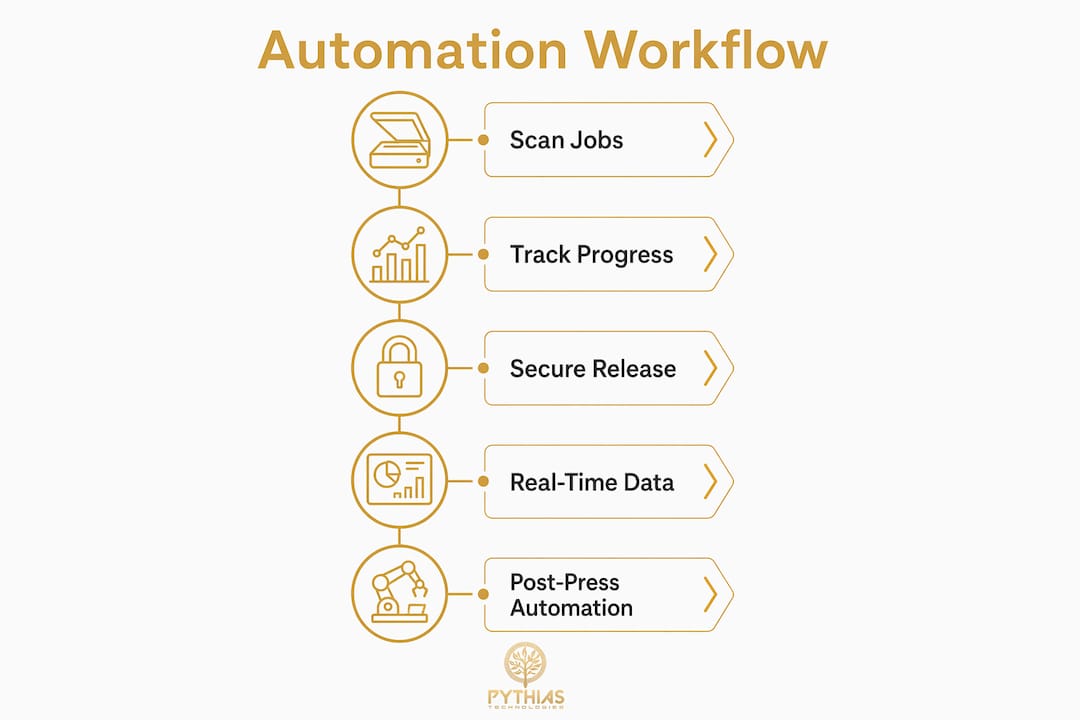
This level of traceability is what separates shops that can scale from those that hit a ceiling. When you can see exactly where every order sits across your DTF, DTG, and embroidery lines at any moment, you can make staffing and scheduling decisions based on data rather than guesswork.
Post-press automation extends these gains to the end of the production line. The Duplo DC-ST100, for example, supports continuous stacking and unload-on-the-run, meaning operators can remove finished stacks without stopping the line. That single capability keeps printer utilization high and removes the bottleneck that manual unloading creates during peak runs.
| Integration point | Manual process | Automated process |
|---|---|---|
| Job status tracking | Paper forms, verbal updates | Real-time SQL dashboard |
| Rework routing | Manual identification and sorting | Automated queue assignment |
| Post-press unloading | Operator stops line to unload | Continuous stacking with live unload |
| Audit history | Manual search through records | Queryable database with full lot traceability |
Pro Tip: Connect your print station data to your order management system so that production status updates flow directly to your fulfillment queue. This eliminates the manual step of checking production before generating shipping labels, which is a common source of delay in high-volume print-on-demand operations.
What are the biggest challenges of print automation adoption?
FESPA’s Print Census 2025 found that nearly half of print businesses do not use automation, with infrastructure gaps, knowledge deficits, and cost concerns cited as the primary barriers. Automation is more common in prepress and web-to-print than on the production floor, which means many shops have partial solutions that do not connect. That partial coverage is often worse than no automation at all, because it creates false confidence while leaving manual handoffs in place at critical points.
The knowledge gap is real and underestimated. Many print shop owners understand the concept of automation but lack the technical staff to evaluate, implement, and maintain integrated systems. Vendors often oversell ease of deployment, and shops end up with tools that require more configuration than anticipated.
The following steps represent a practical path through these barriers:
- Audit your current workflow to identify every manual handoff, paper form, and verbal status update. These are your automation targets.
- Prioritize integration over features. A basic barcode system that connects to your existing order management platform delivers more value than a feature-rich tool that operates in isolation.
- Start with one production line. DTF or DTG operations are good candidates because job volumes are high and errors are costly. Prove the model before expanding.
- Evaluate managed print services as a deployment path. MPS providers handle fleet optimization and policy configuration, reducing the technical burden on your team.
- Align automation with your fulfillment stack. Print station efficiency gains disappear if the downstream fulfillment process is still manual. Print-on-demand integrations that connect production data to order routing and shipping automation close that gap.
The shops that succeed with automation treat it as an operational system, not a technology project. The goal is a production floor where every order is traceable, every handoff is logged, and every exception is handled by a rule rather than a person.
Key takeaways
Print station automation delivers measurable gains in efficiency, security, and traceability only when stations are connected to a centralized data system rather than operated in isolation.
| Point | Details |
|---|---|
| Secure print release reduces waste | Jobs held in authenticated queues eliminate abandoned and duplicate prints across production lines. |
| Barcode integration enables traceability | Every scan writes to a central database, replacing paper forms with real-time dashboards and audit history. |
| Post-press automation protects throughput | Continuous stacking systems like the Duplo DC-ST100 keep printer utilization high by removing manual unload stops. |
| Partial automation creates new risks | Automating isolated stations without full integration reintroduces manual handoffs and negates traceability gains. |
| Adoption barriers are solvable | Modular rollouts, managed print services, and fulfillment-connected platforms lower the cost and complexity of deployment. |
Why automation is about control, not just speed
I have watched print shops invest in automation and come away disappointed, and the pattern is almost always the same. They automated the visible bottleneck, usually the press or the prepress queue, and left the handoffs between stations exactly as they were. Output speed went up. Error rates stayed flat. Waste continued. The investment looked good on paper and felt hollow in practice.
The real value of print station automation is control, not velocity. When every job is authenticated before it prints, when every scan writes to a shared record, and when rework is routed by a rule rather than a conversation, you have a production floor that behaves consistently regardless of who is working that shift. That consistency is what allows you to scale. You cannot grow a custom apparel or print-on-demand operation by adding headcount if the underlying process is unpredictable.
AI-driven inspection tools are the next layer of this control system. Roberts from Postpress Magazine describes the near-term future as augmented automation, where AI supports human operators with real-time inspection and decision-making rather than replacing them. That framing is useful. The shops that will lead in the next five years are not the ones that automate the most. They are the ones that build production systems where automation and skilled operators each do what they do best.
View automation as a production operating system, not a collection of tools. Every station, every scan, and every data point should feed a single source of truth. When it does, you stop managing chaos and start managing a business.
— Michael Thero
How Pythias Technologies helps print shops automate production
Print shops that want to connect station-level automation to their broader fulfillment and order management operations need more than individual tools. They need a production operating system.
Pythias Fulfillment Cloud is built specifically for print shops, DTF and DTG businesses, embroidery companies, and custom apparel decorators. The platform integrates production scheduling, barcode scanning, inventory tracking, shipping label generation, and order management into a single system. When a job completes at the press, the fulfillment queue updates automatically. Shipping labels generate without manual input. Inventory adjusts in real time. For shops selling across Shopify, Etsy, Amazon, or Walmart, Pythias Commerce Cloud synchronizes orders and product data across every channel from one place. Book a demo at Pythias Technologies to see how the platform fits your production workflow.
FAQ
What is print station automation?
Print station automation is the practice of using secure print release, barcode tracking, and centralized data integration to move print production from manual, uncontrolled output to rules-based workflows. It covers prepress routing, press-side authentication, quality control, and post-press finishing.
How does secure print release reduce waste?
Secure print release holds jobs in a virtual queue until an authenticated user releases them at the device, eliminating abandoned and duplicate prints. Mopria Alliance confirms that PIN and badge-based authentication works across printer brands without requiring new hardware.
What are the main barriers to print automation adoption?
FESPA’s 2025 Print Census identifies infrastructure gaps, knowledge deficits, and cost concerns as the leading barriers, with nearly half of print businesses still operating without automation. Modular rollouts and managed print services are the most practical paths through these obstacles.
How does post-press automation affect overall print station efficiency?
Post-press automation, such as the continuous stacking capability in the Duplo DC-ST100, keeps printer utilization high by allowing operators to unload finished stacks without stopping the production line. This removes a common bottleneck that limits throughput during high-volume runs.
How does print automation connect to fulfillment operations?
When print station data integrates with an order management system, production status updates flow directly to the fulfillment queue, triggering shipping label generation and inventory adjustments without manual input. Platforms like Pythias Fulfillment Cloud provide this connection for DTF, DTG, and custom apparel operations.
Recommended
- The Role of Print Queue Management for Businesses | Pythias Technologies | Pythias Technologies
- Print Shop Quoting Software: What Owners Must Know | Pythias Technologies
- Pythias Fulfillment Cloud — The Production OS for Print Shops | Pythias Technologies
- DTG Printing Order Management for Print Shops in 2026 | Pythias Technologies | Pythias Technologies