

Print Management Company: A Guide for Print & Apparel Ops
A print management company is a specialized service provider that takes full ownership of a business’s printing environment, covering device monitoring, supply replenishment, maintenance, and document security under a single managed contract. The industry term for this service model is managed print services (MPS). For business owners and operations managers in print and apparel, understanding the difference between a basic printing vendor and a true print management company is the first step toward controlling costs and scaling production. Providers like PaperCut, FUTERA, and Taylor demonstrate how far this model has evolved beyond toner delivery.
What does a print management company actually do?
A print management company delivers managed print services as a structured service model where the provider takes full responsibility for your entire print environment. That includes hardware monitoring, proactive maintenance, automated supply replenishment, and security configuration. The goal is to replace fragmented vendor billing and reactive repair calls with a single, predictable monthly cost.
Most providers price their contracts on a cost-per-page basis. This means you pay for what you print, not for the equipment sitting idle. That pricing structure removes the guesswork from print budgeting and makes it easier to forecast operational expenses quarter over quarter.
The implementation process follows a defined sequence:
- On-site audit. The provider evaluates your current hardware fleet, usage volumes, and workflow patterns. This baseline data drives every decision that follows.
- Solution design. Based on audit findings, the provider recommends device consolidation, software tools, and security protocols tailored to your environment.
- Phased rollout. Software agents, remote monitoring tools, and secure print release systems are deployed in stages to avoid disrupting active production.
- Ongoing management. The provider monitors device health, dispatches technicians proactively, and replenishes supplies before shortages occur.
- Reporting and review. Monthly or quarterly reports give you visibility into usage, costs, and any security events.
Pro Tip: Request a staged rollout plan from any provider before signing a contract. Deploying monitoring software and new print protocols across an entire shop floor at once creates unnecessary downtime. A phased approach protects your production schedule.
For print and apparel businesses running DTF, DTG, or embroidery operations, the audit phase is especially valuable. It surfaces hidden costs like over-specified devices running at low capacity, or under-specified machines creating bottlenecks during peak production runs.

Key benefits of outsourcing print management
Outsourcing print management to a dedicated provider delivers measurable advantages across cost, security, and operational visibility. These benefits compound over time as the provider accumulates usage data and refines your print environment.
- Cost predictability. Cost-per-page contracts replace unpredictable repair invoices and emergency supply orders. Print analytics track every job’s details, enabling internal chargebacks that recover previously hidden printing costs.
- Reduced IT workload. Remote monitoring handles device alerts automatically. Your internal team stops fielding printer support tickets and focuses on production.
- Security and compliance. Providers like FUTERA configure user authentication and secure print release to prevent sensitive documents from sitting unclaimed at output trays. This is critical in regulated sectors and for apparel brands managing proprietary artwork files.
- Scalability for distributed operations. Modern MPS solutions are built for hybrid and multi-location environments. A print and apparel business running fulfillment across multiple facilities can centralize print management without deploying separate IT resources at each site.
- Sustainability tracking. Usage reports identify waste patterns, such as single-sided printing or unnecessary color output, that add cost and material waste to your operation.
“MPS pays for itself by recovering hidden costs, improving security, and enabling strategic decisions based on analytics rather than guesswork.” — PaperCut
The accountability mechanism is worth emphasizing. When every print job is logged and attributed to a department or cost center, managers can see exactly where print spend is concentrated. That data supports better decisions about device placement, paper stock purchasing, and staffing during high-volume production periods.
Print management company vs. traditional vendor vs. MPS provider
These three categories overlap in marketing language but differ significantly in service scope and operational integration. Understanding the distinctions helps you choose the right partner for your production environment.
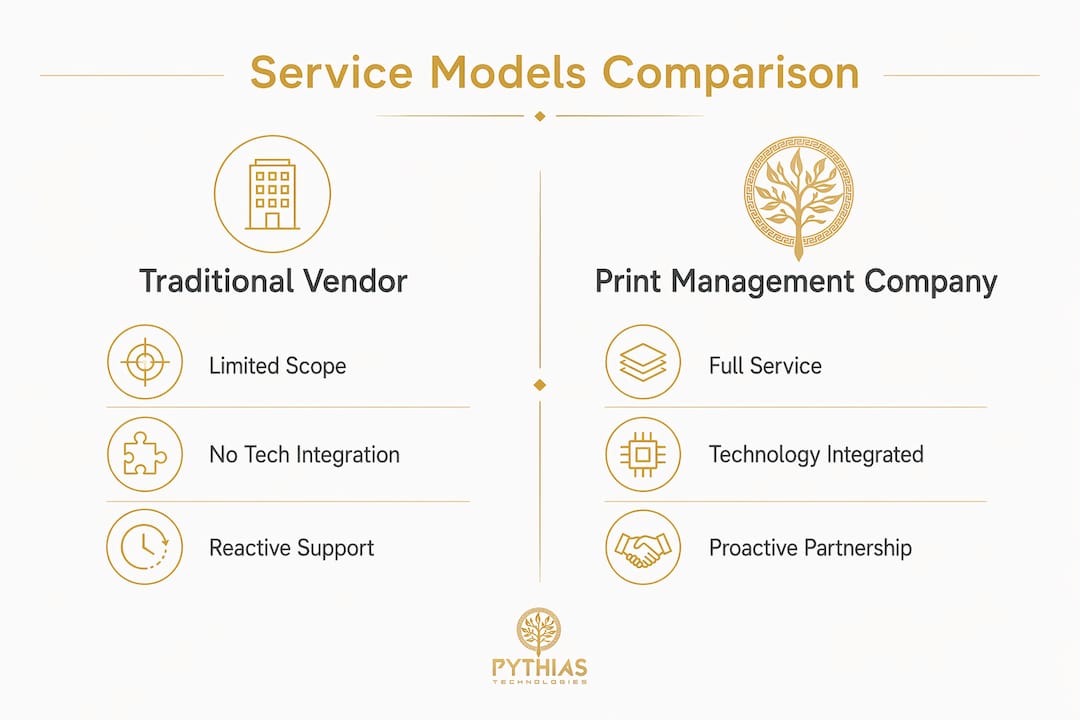
| Category | Service Scope | Technology Integration | Best Fit |
|---|---|---|---|
| Traditional printing vendor | Sells or leases hardware; reactive service calls | Minimal; device-level only | Low-volume, single-location offices |
| MPS provider | Monitors, maintains, and manages devices; cost-per-page billing | Remote monitoring, supply automation, reporting | Mid-to-large offices with multiple devices |
| Print management company | Full lifecycle management including prepress, supply chain, packaging, and digital portals | End-to-end workflow integration | High-volume production, apparel, and enterprise environments |
A traditional vendor sells you a printer and responds when it breaks. An MPS provider monitors that printer and manages its lifecycle. A full-service print management company goes further. Providers like Taylor manage complex production workflows that include artwork prepress, packaging, inventory management, and large-format installations through digital portals that give clients real-time visibility into every job.
For custom apparel and print-on-demand businesses, this distinction matters. You are not just printing documents. You are managing SKUs, artwork files, production queues, and fulfillment timelines. A vendor who drops off toner cartridges does not solve those problems. A print management company that integrates with your production workflow does.
Specialized providers like Dominion Print operate as full-cycle production partners, handling creative, fabrication, and nationwide installation. That model contrasts sharply with a traditional vendor relationship and illustrates how far the category has expanded. For print file management in print-on-demand environments, the same principle applies: you need a partner with workflow depth, not just hardware coverage.
How to select and integrate a print management partner
Selecting the right print management partner requires a structured evaluation process. The wrong choice creates dependency on a provider whose capabilities do not match your production complexity.
Follow these steps to make a sound decision:
- Audit your current environment first. Document every device, its monthly volume, its age, and its maintenance history. This data gives you negotiating leverage and prevents providers from overselling capacity you do not need.
- Define your service requirements. Separate must-haves from nice-to-haves. For a DTG or embroidery operation, secure artwork handling and production queue visibility may be non-negotiable. For a fulfillment provider, automated supply replenishment and uptime guarantees matter most.
- Evaluate technology compatibility. The provider’s monitoring and reporting software must integrate with your existing production systems. Ask specifically about API availability and compatibility with platforms like Pythias Fulfillment Cloud, which manages production scheduling, inventory tracking, and order management for print shops and apparel decorators.
- Assess contract flexibility. Production volumes in apparel fluctuate seasonally. A rigid cost-per-page contract that does not account for volume spikes creates cost overruns during peak periods. Negotiate tiered pricing or volume bands.
- Check sector-specific experience. A provider experienced in office document management may not understand the workflow demands of a high-volume DTF shop. Ask for references from businesses in your sector.
- Plan the integration rollout with your team. Involve production supervisors, IT staff, and floor operators in the transition plan. Staff who understand why changes are happening adopt new workflows faster and surface practical problems before they become costly.
Pro Tip: Involve your cross-functional team in the provider evaluation, not just IT or operations leadership. Floor operators who use the equipment daily will identify workflow gaps that management-level audits miss.
Print queue management is one area where technology selection during integration pays long-term dividends. A well-configured queue system reduces job errors, prioritizes urgent orders, and gives production managers real-time visibility into throughput. Pairing that with Pythias Fulfillment Cloud’s production scheduling creates a tightly coordinated workflow from order intake to shipping label generation.
Key takeaways
A print management company delivers the most value when its service scope matches your production complexity, your team is involved in the transition, and its technology integrates with your existing workflow systems.
| Point | Details |
|---|---|
| Define the service model | Distinguish between traditional vendors, MPS providers, and full-service print management companies before evaluating options. |
| Audit before you buy | Complete an on-site usage and hardware audit to establish a baseline and avoid overpaying for unnecessary capacity. |
| Prioritize workflow integration | Choose a provider whose technology connects to your production scheduling and inventory systems. |
| Use analytics for accountability | Print job tracking and internal chargebacks recover hidden costs and support data-driven production decisions. |
| Plan a staged rollout | Phased implementation protects production continuity and gives staff time to adapt to new protocols. |
Print management is becoming a production strategy, not just a cost control tool
I have watched the conversation around print management shift considerably over the past several years. When operations managers first started asking about managed print services, the pitch was almost always about cutting costs. Reduce your print spend by some percentage. Consolidate your devices. Stop paying for toner you did not order. That framing was useful, but it undersold what a capable provider actually delivers.
The businesses I see getting the most out of their print management relationships are treating their provider as a production partner, not a maintenance contractor. They are sharing production forecasts, integrating provider reporting into their operations reviews, and using print analytics to make decisions about staffing and equipment investment. That is a fundamentally different relationship than calling a vendor when a printer jams.
The shift toward cloud-native workflows and AI-powered analytics is accelerating this change. Providers who can connect their monitoring data to broader production systems give operations managers a level of visibility that was not practical five years ago. For apparel and print-on-demand businesses specifically, this matters because your print environment is not separate from your fulfillment operation. It is part of it.
The security dimension is also underappreciated. Artwork files, customer data, and proprietary design assets move through print environments constantly. Authentication and secure print release are not just compliance checkboxes. They protect your competitive assets.
My honest recommendation: stop evaluating print management companies on price per page alone. Evaluate them on how deeply they can integrate with your production workflow and how much visibility their reporting gives you. The cost savings follow from that integration. They do not precede it.
— Michael Thero
How pythias technologies supports your print and apparel operations
Print management does not stop at the device level. For print shops, DTF and DTG businesses, embroidery companies, and fulfillment providers, the real efficiency gains come from connecting print management to production scheduling, inventory control, and order fulfillment in a single system.

Pythias Technologies builds exactly that infrastructure. Pythias Fulfillment Cloud automates production scheduling, barcode scanning, shipping label generation, and warehouse operations for print and apparel businesses. Pythias Commerce Cloud connects your product catalog to Shopify, Etsy, Amazon, Walmart, TikTok Shop, and other sales channels, keeping inventory and order data synchronized across every platform. If you are scaling a print-on-demand operation and need production workflow software that integrates with your print environment, Pythias Technologies is built for that exact use case. Book a demo to see how the platform fits your operation.
FAQ
What is a print management company?
A print management company is a service provider that oversees all aspects of a business’s printing environment, including device monitoring, maintenance, supply replenishment, and security, typically under a managed contract with cost-per-page pricing.
How is managed print services different from buying a printer?
Managed print services is a data-driven service model that delivers ongoing visibility, cost control, and proactive maintenance. Purchasing a printer is a one-time transaction with no ongoing operational management included.
What should print and apparel businesses look for in a print solutions provider?
Look for a provider with sector-specific experience, technology that integrates with your production workflow, flexible contract terms that accommodate seasonal volume changes, and reporting tools that give you real-time usage visibility.
How does print management improve security for apparel businesses?
Providers configure user authentication and secure print release to prevent sensitive documents and artwork files from being accessed by unauthorized users. Audit trails and authentication meet compliance requirements and protect proprietary design assets.
How long does it take to implement managed print services?
Implementation timelines vary by fleet size and complexity, but a phased rollout typically spans several weeks, starting with an on-site audit and progressing through software deployment and staff training before full activation.
Recommended
- Garment Printer Software Checklist for Print Pros | Pythias Technologies | Pythias Technologies
- Optimize Your Garment Printing Shipping Workflow | Pythias Technologies | Pythias Technologies
- DTG Printing Order Management for Print Shops in 2026 | Pythias Technologies | Pythias Technologies
- Print on Demand Products: Top 10 for Entrepreneurs | Pythias Technologies | Pythias Technologies