

Rush job pricing in printing is an additive cost structure layered over standard production rates to compensate for schedule compression, queue disruption, and expedited delivery requirements. Print professionals who understand how this pricing works can quote accurately, protect margins, and avoid the common trap of undercharging urgent orders. Understanding rush order management is the first step toward running a profitable, high-velocity print operation. Pythias Fulfillment Cloud is one platform built to help shops manage these complexities without manual guesswork.
How rush job pricing works in printing: the core components
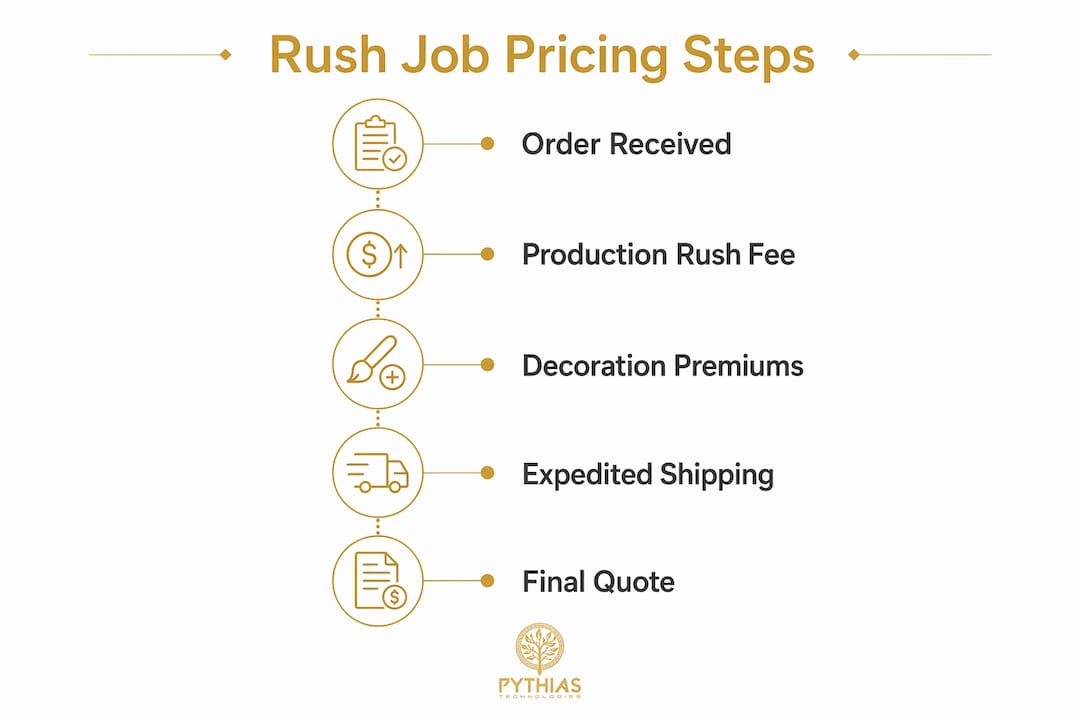
Rush pricing in print workflows includes three distinct cost buckets: a production rush fee for schedule compression, per-piece decoration premiums when faster decoration steps are required, and expedited shipping charges when tight in-hand dates demand faster carrier service. Each component is separate and additive. Combining all three on a single order can significantly increase the total price beyond what clients expect from a simple “rush” request.
Production rush fee
The production rush fee covers overtime labor, expedited press setups, and the cost of jumping an order ahead of existing queue positions. Rush fees are priority fees applied on top of standard costs for labor and queue adjustments, and each job requires an individual quote. Two identical print jobs can carry different rush fees depending on what is already running on the production floor when the request arrives.

Decoration premiums
Decoration premiums apply when a faster turnaround is required at a specific decoration step, such as DTF transfers, DTG printing, embroidery, or screen printing. Not every rush order triggers a decoration premium. The premium appears when the decoration process itself must be accelerated, pulling resources away from other scheduled work.
Expedited shipping costs
Expedited shipping is frequently the largest single cost in a rush order, and it is always a separate line item. Separating production and transit urgency is best practice because shipping costs frequently overshadow the production rush premium. Some printers, like Azul Prints, charge standard print price plus UPS Next Day Air shipping fees with no per-sheet rush surcharge at all. That model makes the cost structure transparent and easier for clients to understand.
| Cost Component | What It Covers | Typical Impact |
|---|---|---|
| Production rush fee | Overtime labor, queue-jumping, expedited setups | Moderate to high |
| Decoration premium | Faster DTF, DTG, embroidery, or screen print steps | Moderate |
| Expedited shipping | Carrier upgrade from ground to air service | Often the largest cost |
Pro Tip: Always quote production rush fees and expedited shipping as separate line items. Clients who see a single inflated total are more likely to push back than clients who see a clear breakdown of what each acceleration costs.
How do turnaround times affect rush pricing tiers?
Rush pricing is not a single flat surcharge. It scales with how aggressively the schedule is compressed. Typical rush premiums range 15–60% above standard production costs depending on turnaround urgency. That range is wide because the operational disruption at 24 hours is fundamentally different from the disruption at five days.
A practical tier structure looks like this:
- Standard (5–10 days): No rush fee. Orders enter the normal production queue.
- Rush (3–5 days): Surcharge of 15–25% above base production cost. Orders move ahead in queue with minimal disruption.
- Super Rush (2 days): Surcharge of 25–40%. Significant queue rescheduling required.
- Same day or next day (24–48 hours): Surcharge of 40–60%. Maximum disruption, overtime labor, and possible partial fulfillment.
DiggyPOD uses established production tiers named Standard, Rush, and Super Rush, with faster tiers moving orders ahead in queue without changing materials. The naming convention matters because it sets client expectations before the quote conversation begins.
Pricing multipliers offer another way to structure fees. Multiplier models use 1.25× for 48–72 hour rush and 1.5× to 2× for same day or next day orders. These multipliers tie the fee directly to the disruption level, making the pricing logic defensible to clients.
One factor that print professionals often overlook: the turnaround clock does not start at order placement. Turnaround time depends on prompt payment processing and proof approvals. A client who takes six hours to approve a proof on a 24-hour rush job has effectively consumed a quarter of the available production window. Build this reality into your rush pricing policies and client communications.
Pro Tip: State explicitly in your rush order confirmation that the clock starts after payment clears and proof is approved. This protects your shop from disputes when slow client approvals push delivery past the committed date.
What practical challenges affect rush job acceptance and pricing?
Rush orders do not exist in isolation. Every rush job lands on a production floor that already has scheduled work in progress. Rush pricing must account for re-ticketing, reordering press runs, and expediting inventory sourcing, which means similar jobs can carry different rush fees depending on the current queue context.
The key operational challenges print shops face with rush orders include:
- Queue disruption: Inserting a rush job ahead of existing orders may require rescheduling multiple jobs, not just one.
- Inventory availability: Rush orders sometimes require pulling stock that was reserved for other jobs or placing emergency reorders with suppliers.
- Prepress rework: Expedited setups may require repeating prepress steps out of sequence, adding labor cost.
- Margin risk: Shops that negotiate rush fees case by case, rather than applying documented tiers, consistently leave money on the table.
Defining clear rush pricing policies with tiers, cutoffs, and eligibility rules prevents margin leakage and quote inconsistencies caused by client negotiations. A shop without documented rush tiers will quote differently every time, making it impossible to track whether rush jobs are actually profitable.
There is also a hard limit that no premium can overcome. If the requested delivery date is sooner than the shop’s production floor minimum, the order must be refused or restructured. Options include partial shipments of available inventory, switching to an alternative product that can be produced faster, or negotiating a revised in-hand date. Accepting an order you cannot fulfill damages client relationships far more than declining it upfront.
“Rush is not just faster work. It is buying production capacity and disrupting existing schedules. The premium reflects opportunity cost and operational risk, not merely overtime pay.” — Invoice Quickly
How can print shops use software to manage rush job pricing?
Manual rush quoting is slow, inconsistent, and prone to errors. Efficient rush quoting benefits from software that integrates production schedules and shipping calculations to produce accurate, dynamic quotes. Pythias Fulfillment Cloud is built specifically for this workflow, connecting production scheduling, inventory tracking, and shipping carrier integrations into a single platform for DTF shops, DTG businesses, embroidery companies, and apparel decorators.
Key capabilities that directly affect rush job pricing accuracy include:
- Real-time job status monitoring: Assess current queue load before committing to a rush timeline. If the floor is at capacity, the system surfaces that constraint immediately.
- Automated quoting with production and shipping variables: Generate quotes that incorporate current production tier fees, decoration premiums, and live carrier rates in a single step.
- Shipping carrier integration: Pull actual UPS, FedEx, and USPS rates for overnight and two-day services at quote time, not after the job is accepted. This eliminates the common error of underquoting expedited shipping.
- Inventory visibility: Confirm stock availability for rush orders before committing to a timeline. Pythias Fulfillment Cloud’s inventory management tools flag shortages that would make a rush timeline impossible.
- Production scheduling automation: Automatically slot rush orders into the correct queue position based on tier rules, reducing manual rescheduling effort.
Print shop quoting software that connects these variables produces quotes that are both accurate and defensible. Shops using automated quoting tools report fewer pricing disputes and more consistent margins on rush work. The role of shipping carrier integration is particularly significant because live carrier rates change daily, and a quote built on yesterday’s rates can erode margin on overnight shipments.
Pro Tip: Use real-time job status data to set a daily rush order cutoff time. Orders received after that cutoff automatically move to the next tier. This protects the production floor and removes the pressure of case-by-case negotiation.
Key Takeaways
Rush job pricing in printing combines a production rush fee, decoration premiums, and expedited shipping costs, with total surcharges ranging from 15% to 60% above base rates depending on how tightly the schedule is compressed.
| Point | Details |
|---|---|
| Three cost components | Production rush fee, decoration premiums, and expedited shipping are always separate line items. |
| Tiered surcharge rates | Rush premiums range from 15–25% at 5–7 days to 40–60% for same-day or next-day orders. |
| Clock starts after approval | Turnaround time begins after payment clears and proof is approved, not at order placement. |
| Production floor limits | Orders that fall below the shop’s minimum production time must be refused or restructured. |
| Software reduces errors | Automated quoting tools that integrate production schedules and live carrier rates produce consistent, accurate rush quotes. |
The real cost of rush work is rarely where shops expect it
After years of watching print shops price rush jobs, the pattern I see most often is this: shops focus on the production premium and forget the shipping. A 40% production rush fee on a $200 order adds $80. Overnight UPS shipping on that same order can add $60 to $120 depending on weight and destination. The shipping cost is not a footnote. It is frequently the deciding factor in whether a rush order is worth accepting at all.
The second mistake I see constantly is inconsistent pricing. A shop owner quotes $50 extra for rush on monday, then $30 on friday because the floor happens to be lighter. That inconsistency is not generosity. It is margin leakage with no upside. Clients who got the $30 quote will expect it again, and they will tell other clients. Documented tiers with published cutoffs eliminate this problem entirely.
The third thing I have learned is that refusing a rush order is sometimes the best business decision you can make. Accepting an order you cannot fulfill on time, at a price that does not cover your actual costs, is worse than losing the sale. Shops that build clear feasibility checks into their quoting process, whether through software like Pythias Fulfillment Cloud or a well-documented manual process, make better decisions under pressure.
The shops that handle rush work profitably are not the ones with the fastest presses. They are the ones with the clearest pricing rules, the most accurate shipping cost data, and the discipline to apply both consistently.
— Michael Thero
Pythias Technologies: rush job pricing built into your workflow
Pythias Technologies built Pythias Fulfillment Cloud to give print shops, DTF businesses, embroidery companies, and fulfillment providers the production visibility they need to quote and manage rush jobs accurately. The platform connects real-time job status, production scheduling, inventory tracking, and shipping carrier integrations into one system. That means your rush quotes reflect actual floor capacity and live carrier rates, not estimates. Shops using print-on-demand automation software from Pythias Technologies reduce manual quoting errors and protect margins on every urgent order. Book a demo to see how Pythias Fulfillment Cloud handles rush order workflows from quote to shipment.
FAQ
What is a rush fee in printing?
A rush fee is a surcharge added to standard production costs to compensate for overtime labor, queue disruption, and expedited setups required to complete a job faster than normal. Each job is individually quoted because the fee depends on current floor conditions.
How much does rush printing typically cost?
Rush printing surcharges range from 15–25% above base cost for 5–7 day turnarounds, 25–40% for 3–5 days, and 40–60% for 24–48 hour orders. Expedited shipping is an additional separate cost on top of these production premiums.
Does rush printing always include faster shipping?
No. Production speed and shipping speed are separate cost levers. A shop can rush production and still ship ground, or use standard production with overnight shipping. Separating these two costs helps identify the most cost-effective combination for each order.
When can a print shop refuse a rush order?
A print shop can and should refuse a rush order when the requested in-hand date falls inside the shop’s production floor minimum. Alternatives include partial shipments, product substitutions, or a revised delivery date.
How does software help with rush job pricing?
Real-time job status monitoring lets shops assess queue capacity before committing to a rush timeline. Automated quoting tools that pull live carrier rates and current production tier fees produce accurate quotes faster and with fewer pricing errors than manual methods.
Recommended
- How Rush Order Management Works for Print Shops | Pythias Technologies
- Pythias Fulfillment Cloud — The Production OS for Print Shops | Pythias Technologies
- Print Shop Quoting Software: What Owners Must Know | Pythias Technologies
- Garment Printer Wholesale Pricing Best Practices | Pythias Technologies