

Real-time inventory tracking is defined as the continuous, instantaneous monitoring of stock quantities and item locations across every warehouse, sales channel, and fulfillment point as each transaction occurs. Unlike periodic counts or end-of-day batch updates, this approach gives inventory managers a single source of truth at any moment. Technologies like RFID, Bluetooth Low Energy (BLE) beacons, barcode scanning, and cloud inventory software platforms power this capability. Platforms like Pythias Fulfillment Cloud and Pythias Commerce Cloud are built specifically to support this kind of live data synchronization, connecting production, warehouse operations, and multichannel selling into one system.
What is real-time inventory tracking and how does it work?
Real-time inventory tracking works by capturing stock data at the exact moment a transaction happens, then pushing that data instantly to a connected system. The industry term for this architecture is a perpetual inventory system, which contrasts with periodic inventory systems that only update stock counts at scheduled intervals.
The process relies on several layers working together:
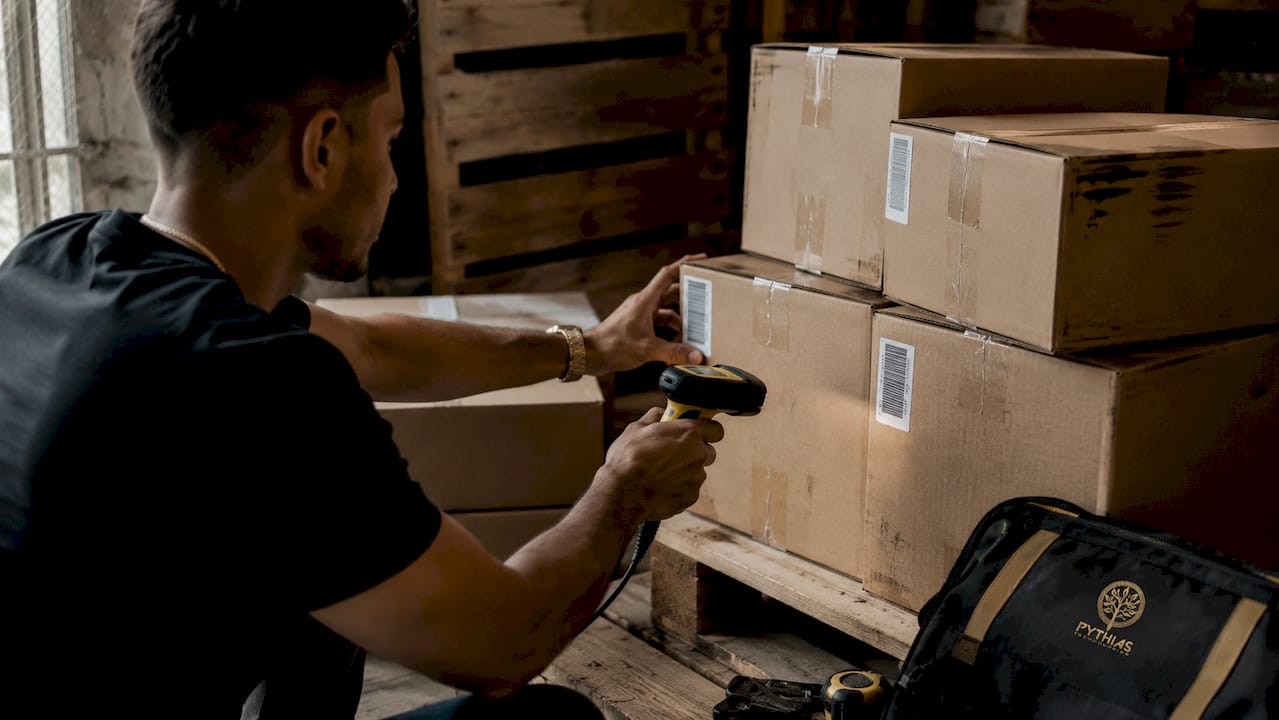
- Scanning and tagging: RFID tags, barcodes, and BLE beacons are attached to individual items, pallets, or storage locations. Each scan or signal triggers an immediate data capture event.
- Data transmission: Mobile scanners, fixed readers, or IoT sensors send the captured data to a warehouse management system (WMS) or enterprise resource planning (ERP) platform in real time.
- System update: The WMS or ERP adjusts stock counts, location records, and order statuses automatically, without manual entry.
- Validation at the point of transaction: Guided mobile workflows prompt workers to confirm quantities, locations, and SKUs before completing a move or pick, catching errors before they enter the system.
A mobile warehousing layer combined with an ERP can deliver fast scanning and real-time validation without the full complexity and cost of a standalone WMS. This phased approach lets smaller operations adopt real-time capabilities without overhauling their entire infrastructure at once.
Pro Tip: Start with barcode scanning at receiving and shipping before adding RFID or BLE. These two transaction points generate the most inventory errors, and fixing them first delivers the fastest accuracy gains.
What are the advantages of real-time inventory tracking over traditional methods?
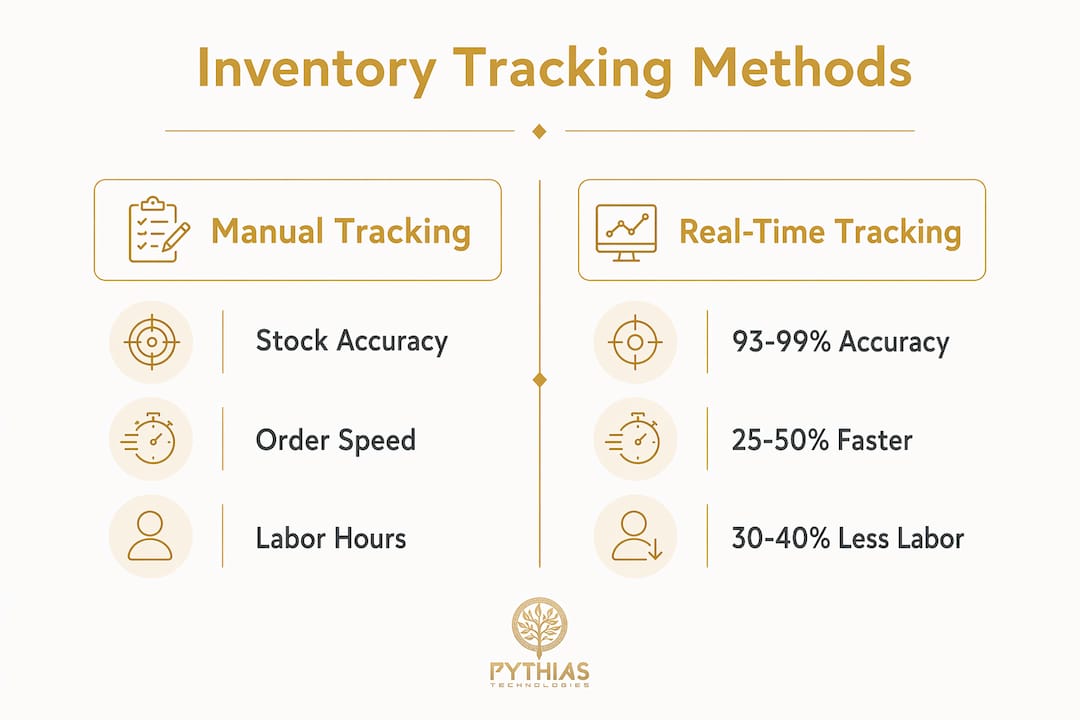
The measurable gains from switching to real-time stock tracking are significant. RFID-based tracking improves stock accuracy to 93–99%, compared to 65–75% with manual methods. That accuracy gap translates directly into fewer lost sales, fewer customer complaints, and lower labor costs spent on recounts and corrections.
Order picking speeds increase by 25–50% and labor hours drop by 30–40% with real-time systems in place. Businesses also see a 20–30% reduction in carrying costs and a 15–20% drop in cart abandonment in e-commerce. Lower cart abandonment alone justifies the investment for most online retailers, since it means customers are seeing accurate stock levels before they commit to a purchase.
The table below summarizes how real-time tracking compares to traditional manual methods across key operational metrics:
| Metric | Manual / Periodic tracking | Real-time tracking |
|---|---|---|
| Stock accuracy | 65–75% | 93–99% |
| Order picking speed | Baseline | 25–50% faster |
| Labor hours | Baseline | 30–40% reduction |
| Carrying costs | Baseline | 20–30% lower |
| Cart abandonment (e-commerce) | Baseline | 15–20% lower |
Beyond the numbers, real-time inventory management changes how you respond to supply chain disruptions. When a supplier ships short or a product sells faster than expected, you know immediately. Automated reorder triggers fire when stock hits preset thresholds, so replenishment happens before a stockout occurs rather than after a customer complaint.
Adding more staff to solve inventory inaccuracies is inefficient. Replacing guesswork with a real-time single source of truth drives proactive management, not reactive firefighting.
Comparing real-time inventory tracking technologies: RFID, BLE, barcode scanning, and GPS
No single technology fits every operation. The right choice depends on your volume, budget, physical environment, and the level of location precision you need.
| Technology | Best use case | Accuracy | Implementation complexity | Cost |
|---|---|---|---|---|
| Barcode scanning | Retail, e-commerce, small warehouses | High (scan-dependent) | Low | Low |
| RFID | High-volume warehouses, apparel, manufacturing | 93–99% | Medium | Medium to high |
| BLE beacons | Indoor location tracking, asset management | Sub-meter | Low to medium | Medium |
| GPS | Mobile assets, vehicles, outdoor yards | Moderate | Low | Low to medium |
Barcode scanning is the most accessible entry point. It requires no special infrastructure beyond a scanner and labeled items. The limitation is that every scan requires a direct line of sight and a human action, which slows throughput at high volumes.
RFID removes the line-of-sight requirement. Readers can capture dozens of tags simultaneously as pallets move through a dock door, making it ideal for apparel decorators, DTF businesses, and fulfillment providers processing high SKU counts. RFID-based systems deliver the 93–99% accuracy benchmark cited in retail studies.
BLE-based real-time location systems (RTLS) offer a compelling middle ground. BLE RTLS can deploy in under 7 days without cabling, reaching 99% inventory accuracy quickly. Sub-meter positioning with BLE Angle of Arrival (AoA) technology can identify specific rack bays and shelf levels, drastically cutting the time workers spend searching for misplaced items.
GPS is best reserved for tracking vehicles, trailers, or assets that move between facilities. It is not suited for indoor bin-level location tracking.
Pro Tip: For print shops and fulfillment providers managing both raw materials and finished goods, a two-layer approach works well. Use barcode scanning for receiving and shipping, and add BLE beacons for tracking work-in-progress items across production stations.
How to apply real-time tracking for multichannel and fulfillment operations
Real-time tracking is not just a warehouse tool. For any business selling across multiple channels, it is the primary defense against overselling. Real-time inventory tracking maintains omnichannel visibility and prevents overselling across e-commerce and physical stores simultaneously.
Consider a print-on-demand seller listing products on Shopify, Etsy, and Amazon at the same time. Without live stock synchronization, a sale on one channel may not update the others fast enough, resulting in a duplicate order for an item that no longer exists. Pythias Commerce Cloud solves this by syncing inventory data across all connected marketplaces from a single system, the moment a transaction posts.
For fulfillment operations, real-time data improves every stage of the workflow:
- Receiving: Scan inbound shipments immediately to update available stock and trigger put-away tasks.
- Picking: Guided mobile workflows direct workers to exact bin locations, reducing pick errors and search time.
- Shipping: Scan-to-ship validation confirms the right item leaves with the right label before the package closes.
- Cycle counting: Continuous partial counts replace disruptive full physical inventories, keeping accuracy high without shutting down operations.
- Shrinkage reduction: Every movement is logged, creating an audit trail that identifies where losses occur.
Pythias Fulfillment Cloud supports all of these workflows natively, including barcode scanning, shipping label generation, and production queue management for print shops and apparel decorators. Inventory management for print shops becomes significantly more manageable when every scan updates the system in real time rather than waiting for a nightly batch run.
Real-time tracking is also critical for businesses managing multichannel order management, where a single inventory pool must serve orders from Shopify, Amazon, Walmart, TikTok Shop, and eBay simultaneously. Without live data, allocation errors are inevitable at scale.
Key takeaways
Real-time inventory tracking is the most direct path from inventory inaccuracy to operational control, and the technology to implement it is more accessible than most businesses realize.
| Point | Details |
|---|---|
| Definition matters | Real-time tracking updates stock instantly at each transaction, unlike periodic systems that batch updates. |
| Accuracy gains are measurable | RFID and BLE systems reach 93–99% stock accuracy versus 65–75% with manual methods. |
| Start with high-impact points | Scan at receiving and shipping first to capture the most common error sources before expanding. |
| Multichannel requires live data | Selling on multiple platforms without real-time sync creates overselling risk and lost customer trust. |
| Phased adoption reduces risk | A mobile scanning layer added to an existing ERP delivers real-time benefits without a full WMS overhaul. |
Why the mindset shift matters more than the technology
I have worked with enough inventory operations to know that the technology is rarely the hard part. The hard part is changing the habit of recording transactions after the fact instead of at the moment they happen.
Missing exceptions at transaction time is the primary cause of real-time tracking implementation failures. A worker who scans a pallet after moving it, rather than before, has already broken the chain. The system shows a location that no longer reflects reality, and every downstream decision built on that data is compromised.
My honest advice: do not start with a full WMS replacement. Start with a mobile scanning layer that decouples scanning and validation from your ERP. This reduces complexity, lowers implementation cost, and lets your team build the habit of point-of-scan recording before you add more sophisticated capabilities.
Training is underrated in most implementations. Workers need to understand why the scan matters, not just how to do it. When the team sees that their scans directly affect what customers see on a product page or what a picker finds in a bin, compliance improves dramatically.
Cloud platforms like Pythias Technologies make phased adoption practical. You can connect barcode scanning, order management, and multichannel inventory synchronization without building custom integrations or managing on-premise servers. The operational agility that comes from accurate, live inventory data is real. I have seen businesses cut their cycle count time by more than half and eliminate entire categories of customer service complaints simply by closing the gap between physical reality and system records.
— Michael Thero
How Pythias Technologies supports real-time inventory and fulfillment automation
Pythias Technologies builds cloud-native platforms designed specifically for print-on-demand businesses, fulfillment providers, and multichannel sellers who need live inventory data to operate efficiently.

Pythias Fulfillment Cloud covers the full warehouse workflow: barcode scanning, production queue management, shipping label generation, and real-time stock updates across every location. Pythias Commerce Cloud synchronizes product catalogs and inventory across Shopify, Etsy, Amazon, Walmart, TikTok Shop, and eBay from a single dashboard, eliminating the overselling risk that comes with manual channel updates. Both platforms integrate with existing ERP and WMS systems, so you do not need to replace your current infrastructure to gain real-time visibility. Explore print-on-demand automation software built for the operational realities of fulfillment and custom apparel businesses, or review fulfillment provider solutions designed for multi-client production environments.
FAQ
What is real-time inventory tracking in simple terms?
Real-time inventory tracking is the process of updating stock counts and item locations instantly as each transaction occurs, rather than at the end of a shift or day. It gives businesses an accurate, live view of what they have and where it is at any moment.
How does real-time inventory tracking differ from periodic inventory?
Periodic inventory systems update stock counts on a schedule, such as weekly or monthly, while real-time systems update at the point of each transaction. The difference in accuracy is significant: real-time systems reach 93–99% accuracy versus 65–75% for manual periodic methods.
What technology is used for real-time stock tracking?
The four main technologies are barcode scanning, RFID, BLE beacons, and GPS. Barcode scanning is the most affordable entry point, while RFID and BLE deliver higher automation and location precision for larger or more complex operations.
Is real-time inventory tracking only for large businesses?
Real-time tracking is critical for any business managing multiple sales channels, regardless of size. A small seller on Shopify and Etsy faces the same overselling risk as a large retailer if inventory is not synchronized live across platforms.
How does real-time tracking reduce costs?
Real-time inventory management reduces carrying costs by 20–30% by minimizing excess stock, and cuts labor hours by 30–40% through faster picking and fewer manual recounts. Automated reorder triggers also prevent stockouts that result in lost sales.
Recommended
- Why Real-Time Job Status Matters for Print on Demand | Pythias Technologies
- Inventory Management Software for Multichannel Sellers | Pythias | Pythias Technologies
- What Is Order Tracking for Printers: A Shop Owner’s Guide | Pythias Technologies
- POD Order Tracking Automation: A 2026 How-To Guide | Pythias Technologies