

Print-on-demand profit margin improvement is the practice of increasing net revenue per sale by controlling costs, pricing deliberately, and reducing operational waste across your fulfillment workflow. Healthy net margins for POD businesses typically fall between 20% and 40%, with niche and premium products pushing well beyond that ceiling. Basic t-shirts yield 25–35%, while mugs, journals, and home decor can reach 76%. Most POD operators leave money on the table not because their products are wrong, but because their pricing math and operational habits are. Platforms like Shopify, Etsy, and Pythias Fulfillment Cloud each play a role in how efficiently you capture that margin.
How to calculate print on demand profit margins accurately
Most POD operators track the wrong number. They look at gross margin, which is selling price minus production cost, and stop there. That number is almost always too optimistic.
The correct formula for setting a price is: Selling Price = Total Cost / (1 - Target Margin). Total cost must include every expense bucket: production, shipping, platform fees, payment processing, an advertising allocation, and a returns allowance. Failing to include all costs results in overestimating profits by 5–10 percentage points. That gap is the difference between a business that scales and one that stalls.
Gross margin measures production efficiency. Net margin measures actual business health. A shirt priced at $28.00 with a $9.00 blank cost looks like a 68% gross margin. Add $4.50 in shipping, $2.80 in Etsy fees, $1.20 in payment processing, and a $1.00 returns allowance, and your net margin drops to roughly 32%. That is the number that matters.
- List every cost bucket. Production, shipping, platform fees, payment processing, ad spend, and returns.
- Calculate net margin, not gross. Subtract all costs from the selling price, then divide by the selling price.
- Apply the pricing formula. Use Selling Price = Total Cost / (1 - Target Margin) to set prices that protect your target.
- Review monthly. Supplier prices, shipping rates, and platform fees change. Your margin calculation must keep up.
Pro Tip: Build a simple spreadsheet with every cost bucket as a separate row. Update it each month when your supplier invoices arrive. Operators who track actual net profit consistently outperform those who rely on estimates.
What pricing strategies actually improve POD margins?
Pricing is the fastest lever you have. A 10% price increase on a product with a 30% net margin adds more profit than a 10% reduction in production cost. Most POD sellers underprice because they anchor to competitors rather than to the value their product delivers.
- Use .99 price endings on mid-range items. A $24.99 price point converts better than $25.00 for impulse purchases. Reserve round numbers for premium or limited-edition products where the price signals quality.
- Set price anchors with product tiers. Offer a standard version and a premium version side by side. The premium option makes the standard look affordable and lifts the average order value across both.
- Run limited-edition drops. Niche-focused limited editions command 15–25% higher price premiums by creating scarcity value for passion communities. Scarcity shifts the buyer’s frame from “is this worth it?” to “will I miss out?”
- Price for your audience’s purchasing intent. A dog breed enthusiast will pay $34.00 for a breed-specific hoodie that a general buyer would pass at $22.00. Niche purchasing intent drives premium pricing far more reliably than traffic volume.
Pro Tip: Test a 15% price increase on your top three SKUs for 30 days. If conversion rate drops less than 10%, the price increase is net positive. Most POD sellers are surprised by how little resistance they encounter.
Operational strategies that reduce costs and increase revenue per order
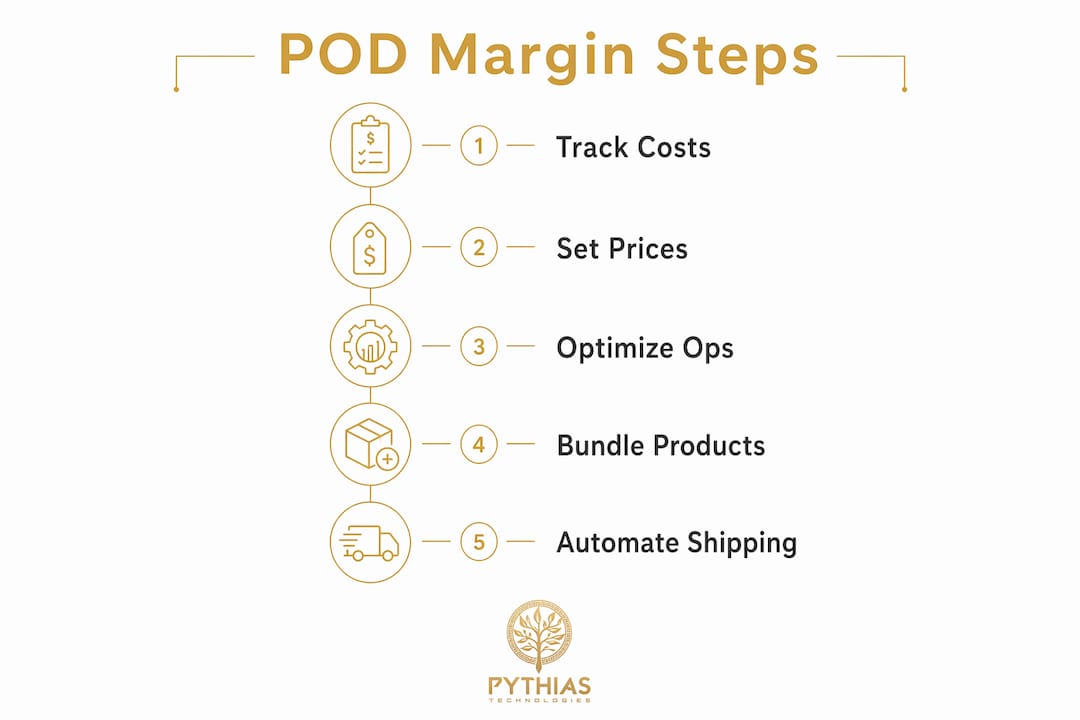
Pricing sets the ceiling. Operations determine how much of that ceiling you actually keep. The most effective operational moves for POD profit margin improvement combine bundling, supplier decisions, shipping management, and automation.

Product bundling
Product bundling increases conversion rates by 8–12% and adds $12–$18 in revenue per order with almost no extra customer acquisition cost. A buyer who came for a mug is a natural candidate for a matching coaster or tote bag. Bundling uses traffic you already paid for to generate more revenue per visit.
Supplier selection and private-label transitions
- Audit your top 10 SKUs by monthly volume. Any SKU exceeding roughly 200 units per month is a candidate for private-label sourcing.
- Request quotes from wholesale blank suppliers. Compare unit costs against your current POD supplier rates.
- Transition high-volume SKUs first. Moving best-selling SKUs to private-label inventory sourcing reduces unit costs by 55–65% and breaks the typical 30% margin ceiling.
- Keep low-volume SKUs on POD. The flexibility of POD is worth the higher unit cost when volume does not justify inventory risk.
Shipping and automation
Shipping cost management is where most POD operators have untapped savings. Multi-item orders shipped together cost far less per unit than single-item shipments. Routing logic that groups orders by destination and weight reduces carrier costs without changing your product mix.
Automation platforms like Pythias Fulfillment Cloud reduce overhead by eliminating manual order entry, routing errors, and duplicate data work. Every manual touchpoint in your fulfillment workflow is a cost. Automating production scheduling, barcode scanning, and shipping label generation removes those costs at scale.
| Strategy | Margin Impact |
|---|---|
| Product bundling | Adds $12–$18 revenue per order with no extra acquisition cost |
| Private-label transition (200+ units/month) | Reduces unit costs by 55–65% |
| Automated order routing | Cuts manual labor costs and reduces fulfillment errors |
| Multi-item shipping optimization | Lowers per-unit shipping cost on grouped orders |
Marketing and retention tactics that protect your margins
Paid advertising is the fastest way to destroy POD margins. On platforms like Meta, CPMs run high and conversion rates for cold audiences are low. Stores relying on paid ads consistently report thinner margins than stores built on SEO traffic and email marketing. The fix is sequencing: validate organic demand before scaling any paid spend.
- Validate niches with organic content first. Post to niche communities on Reddit, Facebook Groups, and Pinterest before running a single ad. If organic posts generate saves and clicks, the niche has purchasing intent worth investing in.
- Build a branded Shopify store alongside your Etsy presence. Using Etsy for discovery and funneling repeat buyers to a branded Shopify store can increase net margins by 15–20 percentage points. Etsy fees disappear on direct sales. Package inserts and QR codes inside shipments drive that transition.
- Invest in email marketing for repeat purchases. A customer who buys twice costs nothing to acquire the second time. Email sequences tied to purchase history, seasonal drops, and new design launches generate revenue at near-zero acquisition cost.
- Consider subscription or membership models. A monthly design club or early-access membership creates predictable revenue. Predictable revenue lets you plan production runs and inventory more efficiently, which further reduces per-unit costs.
The core principle behind all of these tactics is the same: validate organic demand before committing budget. Marketing is sequencing, not spending.
Key takeaways
Print-on-demand profit margin improvement requires accurate cost tracking, deliberate pricing, operational efficiency, and retention-focused marketing working together.
| Point | Details |
|---|---|
| Calculate net margin, not gross | Include production, shipping, fees, ad spend, and returns in every margin calculation. |
| Use the pricing formula | Set prices with Selling Price = Total Cost / (1 - Target Margin) to protect your target margin. |
| Bundle products to lift order value | Bundling adds $12–$18 per order with no extra acquisition cost. |
| Transition high-volume SKUs to private label | SKUs above 200 units per month qualify for sourcing that cuts unit costs by 55–65%. |
| Build direct channels alongside marketplaces | Funneling Etsy buyers to a Shopify store can add 15–20 percentage points to net margin. |
The margin mistakes I keep seeing POD operators make
Most POD businesses I have observed fail at the same two points: they trust theoretical margins, and they scale ad spend before validating demand.
Theoretical margins feel real because the math is simple. You subtract the blank cost from the selling price and the number looks healthy. But the moment you add Etsy’s transaction fee, Stripe’s processing cut, a shipping label, and one return per 20 orders, that number shrinks fast. I have seen operators running what they believed were 45% margin businesses discover their actual net was closer to 18% once every cost was accounted for. The formula is not complicated. The discipline to apply it consistently is what separates profitable operators from busy ones.
The second mistake is scaling paid ads too early. A POD seller who finds a niche that converts organically on Pinterest or in a Facebook Group has real signal. That same seller who immediately pours $3,000 per month into Meta ads before building an email list or a Shopify store is trading margin for vanity metrics. Organic validation first, paid amplification second. That sequence protects margin at every stage of growth.
The technology piece matters more than most operators admit. Manual order management, spreadsheet-based inventory tracking, and copy-paste listing workflows are not free. They cost labor hours, introduce errors, and limit how fast you can scale. Platforms like Pythias Fulfillment Cloud and Pythias Commerce Cloud exist precisely to remove those costs. The operators who treat automation as an expense rather than a margin driver consistently hit a ceiling around $200,000–$300,000 in annual revenue and cannot figure out why growth stalls.
Pace your SKU expansion deliberately. More products do not automatically mean more profit. Every new SKU adds listing work, design cost, and inventory complexity. Evaluate each SKU by its actual net margin contribution, not its gross revenue. Cut the bottom 20% of your catalog every quarter and reinvest that attention into your top performers.
— Michael Thero
How Pythias Technologies supports POD margin growth
POD profit margin improvement is not just a pricing exercise. It is an operations problem, and the right software makes a measurable difference.

Pythias Technologies builds the infrastructure that connects every part of your POD workflow. Pythias Fulfillment Cloud automates production scheduling, order routing, barcode scanning, and shipping label generation for print shops, DTF and DTG businesses, and embroidery operations. Pythias Commerce Cloud syncs your product catalog and orders across Shopify, Etsy, Amazon, Walmart, TikTok Shop, and more from a single dashboard. Together, they eliminate the manual work that quietly erodes margins at scale. Explore POD fulfillment automation to see how Pythias Technologies fits your operation, or book a demo to walk through the platform with the team.
FAQ
What is a good profit margin for print-on-demand?
Healthy POD net margins range from 20% to 40% for most product categories. Niche and premium products like home decor and journals can reach 76%.
How do I calculate my real POD profit margin?
Use the formula Selling Price = Total Cost / (1 - Target Margin) and include every cost: production, shipping, platform fees, payment processing, ad spend, and a returns allowance.
Why are my actual margins lower than expected?
Platform and payment fees plus return allowances reduce realized profit by 5–10 percentage points compared to simple gross margin estimates. Track net margin, not gross.
When should I switch from POD to private-label sourcing?
Switch any SKU that exceeds roughly 200 units per month. Private-label sourcing at that volume reduces unit costs by 55–65% and removes the 30% margin ceiling typical of standard POD fulfillment.
Does selling on Etsy hurt my margins?
Etsy is a strong discovery channel but its fees compress margins. Funneling repeat buyers to a branded Shopify store through package inserts and QR codes can recover 15–20 percentage points in net margin on repeat orders.
Recommended
- Print on Demand Products: Top 10 for Entrepreneurs | Pythias Technologies | Pythias Technologies
- Scaling Print on Demand Operations in 2026: A Practical Guide | Pythias Technologies
- Printing’s Role in Employee Productivity: 2026 Guide | Pythias Technologies
- DTG Printing Order Management for Print Shops in 2026 | Pythias Technologies | Pythias Technologies