

Scaling print on demand operations is defined as the process of systematically increasing order volume, revenue, and production capacity without proportionally raising labor costs or manual workload. The global POD market is projected to reach $37.85 billion by 2030 at a 25.52% CAGR. That growth rate means the window for building scalable infrastructure is now, not later. The businesses that win at scale are not the ones with the largest catalogs. They are the ones with the best-automated workflows, the smartest order routing, and a hybrid fulfillment strategy built for volume. Tools like Order Desk, Printify API, Pythias Fulfillment Cloud, and Pythias Commerce Cloud are the infrastructure layer that separates a $50,000-per-year side business from a seven-figure operation.
What is print on demand scalability and why manual workflows fail
Print on demand scalability is the ability to handle 10x the order volume without 10x the staff. Most POD sellers hit a ceiling not because demand dries up, but because their backend cannot keep pace. Manual order processing, one-by-one file uploads, and copy-paste customer emails are workflows designed for 20 orders a day, not 200.
The bottlenecks are predictable:
- Order processing delays: Manually routing orders to suppliers adds hours per day at volume.
- File management errors: Uploading design files one at a time without standardized color profiles or bleed settings causes reprints and refunds.
- Customer communication gaps: Relying on default supplier emails exposes your third-party fulfillment and erodes brand trust.
- Supplier single points of failure: Using one supplier with no fallback means one stockout kills your entire queue.
“Most scaling failures come from operating at the wrong volume tier. Automation and infrastructure investment distinguishes mid-market winners.”
The core insight here is that scaling depends more on orchestration than catalog size. A seller with 50 well-automated SKUs will outperform a seller with 5,000 manually managed listings every time. The types of POD integrations you build early determine how fast you can grow later. Getting the architecture right at 100 orders per day makes 1,000 orders per day a systems problem, not a hiring problem.
How to automate print on demand workflows to increase capacity

Automation in POD means removing human decision points from repeatable tasks. The goal is a workflow where an order placed on Shopify, Etsy, or Amazon triggers production, file preparation, supplier routing, and customer notification without anyone touching a keyboard.
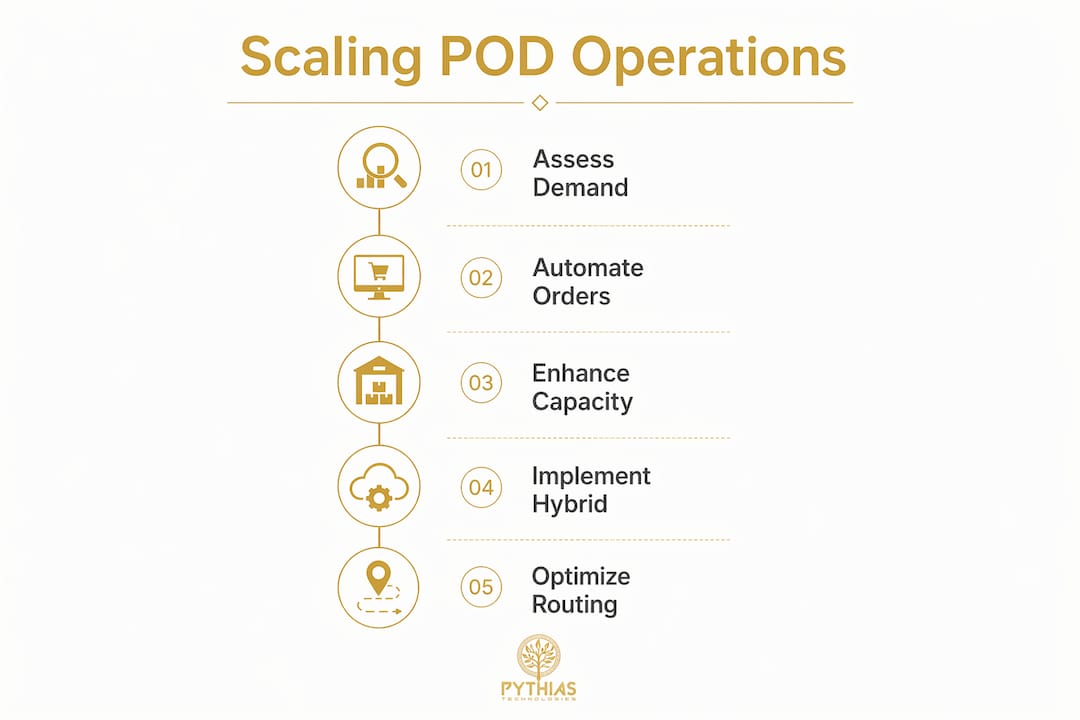
Here is the sequence that high-volume operators use:
- Connect a middleware layer. Order management tools like Order Desk act as a decoupling layer between your sales channels and your production suppliers. Automating order routing through middleware reduces manual steps and improves operational speed by 32%. That means faster production starts and fewer errors caused by manual data entry.
- Standardize your design file pipeline. Every file entering production should be automatically checked and transformed. Automated pipelines handle color profile adjustments, bleed settings, and resolution standards before the file reaches the print queue. This eliminates the most common cause of reprints at scale.
- Build supplier routing rules. Define logic that selects the right supplier based on stock availability, geographic proximity to the customer, SLA commitments, and unit cost. If Supplier A is out of stock on a black XL tee, the system routes to Supplier B automatically.
- Automate customer notifications. Connect tools like Klaviyo to your supplier webhooks so branded tracking emails fire the moment an order ships. Your customer never sees a generic supplier email.
- Audit and iterate. Review routing logs weekly during the first 60 days. Identify which rules fire most often and which suppliers generate the most exceptions.
The results of full automation are significant. End-to-end automation can increase production capacity 3–5x without raising headcount and save $50,000–$70,000 annually in manual labor. That is not a marginal efficiency gain. It is a structural cost advantage that compounds as volume grows.
| Automation Layer | Tool Examples | Primary Benefit |
|---|---|---|
| Order routing middleware | Order Desk, Pythias Fulfillment Cloud | Reduces manual routing by 32% |
| Design file pipeline | n8n, custom scripts | Eliminates file errors before production |
| Customer notifications | Klaviyo, supplier webhooks | Maintains brand equity at scale |
| Multi-channel sync | Pythias Commerce Cloud | Centralizes Shopify, Etsy, Amazon, Walmart |
Pro Tip: Build your routing rules around supplier SLA first, not price. A cheaper supplier that ships two days late will cost you more in refunds and reviews than the savings justify.
When does a hybrid fulfillment model make sense?
A hybrid fulfillment model combines POD for experimental or long-tail designs with pre-built inventory for proven bestsellers. Pure POD works well at low volume. At higher volume, the fixed production time of 3–7 days per order becomes a competitive disadvantage against sellers offering 2-day delivery.
The trigger metrics for moving a design into inventory are specific. Top POD operators move a SKU into inventory runs of 500 units when it hits 150 or more units per month, consistently, for 60 days. They also require a customer lifetime value above $85 and a return rate below 3% before committing capital to inventory. These thresholds exist because inventory ties up cash. You need confidence in the demand signal before you make that bet.
| Factor | Pure POD | Hybrid Model |
|---|---|---|
| Production time | 3–7 days per order | 1–3 days post-production for stocked items |
| Upfront cost | None | Inventory investment required |
| Margin per unit | $5–$12 on a typical t-shirt | Higher margin on proven SKUs |
| Delivery speed | Standard | Near 2-day with 3PL integration |
| Best for | New designs, long-tail SKUs | Bestsellers with consistent demand |
Hybrid fulfillment models that treat production, inventory, and logistics as one connected system enable reliable 2-day delivery. That speed increase directly raises customer lifetime value. Scaling beyond $500,000 in revenue almost always requires this shift. POD handles your catalog breadth. Inventory handles your margin and delivery speed on the products customers already love.
Pro Tip: Use your POD sales data as a demand signal before committing to inventory. If a design sells 150 units in month one, that is not a trend. If it sells 150 units for two consecutive months with a low return rate, that is a signal worth acting on.
How to avoid the most common scaling mistakes
Order orchestration is the real bottleneck in high-volume POD, not design quality or marketing spend. Backend orchestration is the actual product at scale. Pre-warming your systems and validating queue headroom before a campaign launch prevents the kind of downtime that costs thousands in lost orders.
The most common mistakes operators make when scaling:
- Single-supplier dependency. One supplier going offline during peak season can halt your entire operation. Multi-supplier routing with fallback logic based on stock, location, and SLA prevents this. Build at least two qualified suppliers for every core product category.
- Skipping print file automation. At 500 orders per day, a single file error rate of 1% means five reprints daily. Automated print file management catches color profile mismatches, missing bleeds, and resolution failures before they reach the queue.
- Ignoring seasonal pre-warming. Q4, Valentine’s Day, and back-to-school are predictable demand spikes. Test your routing rules, supplier capacity, and notification workflows at least 30 days before peak season. Do not discover a queue bottleneck on Black Friday.
- Using default supplier notifications. Branded customer emails through Klaviyo connected to supplier webhooks keep your brand front and center. Customers who receive a generic email from a supplier they have never heard of lose confidence in your brand, not the supplier.
- Treating DTG and DTF orders identically. DTF transfers and DTG printing have different file requirements, production times, and supplier networks. Your routing rules need to account for print method, not just product type.
Pro Tip: Schedule a quarterly routing audit. Pull your order exception logs, identify the top three failure points, and fix the routing rule or supplier relationship causing them. Most scaling problems are not new problems. They are old problems that grew.
Key takeaways
Scaling print on demand operations requires automation, hybrid fulfillment, and intelligent order routing working together as a single system.
| Point | Details |
|---|---|
| Automate before you scale | Build order routing, file pipelines, and notifications before volume exposes the gaps. |
| Use middleware for routing | Tools like Order Desk reduce manual steps and improve operational speed by 32%. |
| Apply the 150-unit threshold | Move a SKU to inventory only after 150+ units per month for 60 consecutive days. |
| Build multi-supplier fallback | Route orders to a backup supplier automatically when stock or SLA conditions fail. |
| Pre-warm for peak seasons | Validate queue capacity and supplier readiness at least 30 days before demand spikes. |
The part most POD guides skip entirely
I have worked with enough POD operators to know that the automation conversation almost always starts too late. Most sellers build their catalog first, run ads, get traction, and then scramble to fix a backend that was never designed for volume. By that point, they are losing orders, issuing refunds, and manually managing supplier relationships at 11 PM.
The operators who scale cleanly do the opposite. They treat their order orchestration layer as a product decision, not an IT task. They choose middleware like Order Desk or Pythias Fulfillment Cloud before they need it, not after the first Black Friday meltdown. They document their routing rules. They test their file pipelines with edge cases. They know their supplier SLAs by memory.
The hybrid fulfillment shift is also misunderstood. Most guides frame it as a cost decision. It is actually a customer experience decision. When you move a bestselling design into a 3PL-integrated inventory run, you are not just improving your margin. You are delivering in two days instead of seven. That speed difference changes your repeat purchase rate, your review scores, and your ad economics. The future of scalable POD runs on integrated 3PL and workflow automation, and the sellers building that infrastructure now will be very difficult to compete with in 2027.
One more thing: do not underestimate the brand equity cost of poor notifications. I have seen sellers spend thousands on packaging inserts and unboxing experiences, then send customers a tracking email from a supplier they have never heard of. Klaviyo connected to your supplier webhooks costs almost nothing to set up and protects the brand perception you worked hard to build.
— Michael Thero
Scale your POD operations with pythias technologies
Pythias Technologies builds the infrastructure that makes scaling POD operations practical, not theoretical.
Pythias Fulfillment Cloud automates production scheduling, order routing, barcode scanning, shipping label generation, and inventory tracking for print shops, DTF and DTG businesses, and fulfillment providers. Pythias Commerce Cloud connects your product catalog to Shopify, Etsy, Amazon, Walmart, TikTok Shop, and eBay from a single system, keeping orders, inventory, and listings in sync across every channel. Together, they give you the POD automation platform that replaces manual workflows with rules-based orchestration. If you are ready to stop managing orders and start running a scalable operation, book a demo with Pythias Technologies today.
FAQ
What is print on demand scalability?
Print on demand scalability is the ability to increase order volume and revenue without a proportional increase in manual labor or operational complexity. It depends on automated workflows, multi-supplier routing, and intelligent order management systems.
How does automation increase POD production capacity?
End-to-end automation increases production capacity 3–5x without adding headcount and saves $50,000–$70,000 annually in manual labor costs. Automation removes human decision points from order routing, file preparation, and customer notifications.
When should a POD seller switch to a hybrid fulfillment model?
Switch a SKU to inventory when it consistently sells 150 or more units per month for 60 days, with a customer lifetime value above $85 and a return rate below 3%. Scaling beyond $500,000 in annual revenue almost always requires a hybrid model to maintain delivery speed and margins.
What is multi-supplier routing and why does it matter?
Multi-supplier routing automatically directs each order to the best available supplier based on stock levels, geographic location, and SLA commitments. It prevents single-supplier bottlenecks and keeps fulfillment running during stockouts or peak demand periods.
What are the best print on demand automation platforms in 2026?
Order Desk handles order routing and middleware logic. Klaviyo manages branded customer notifications. Pythias Fulfillment Cloud and Pythias Commerce Cloud provide end-to-end fulfillment automation and multi-channel marketplace management for high-volume POD operations.
Recommended
- Software for Print on Demand Businesses — Fulfillment Automation | Pythias | Pythias Technologies
- DTG Printing Order Management for Print Shops in 2026 | Pythias Technologies | Pythias Technologies
- Print Shop Capacity Planning: What Managers Must Know | Pythias Technologies
- Print on Demand Products: Top 10 for Entrepreneurs | Pythias Technologies | Pythias Technologies