

Garment printing compliance labeling is defined as the mandatory inclusion of fiber content, care instructions, country of origin, and manufacturer identification on apparel labels to satisfy federal and international law. The Federal Trade Commission, the Consumer Product Safety Improvement Act (CPSIA), and the EU’s REACH regulation each set binding requirements that apply to every printed garment sold in the US or European markets. Violations can cost up to $51,744 per item, and new digital filing mandates take effect in mid-2026. For garment manufacturers and print service providers, getting labeling right is not a back-office task. It is a core production requirement with direct financial and legal consequences.
What are the mandatory requirements for garment printing compliance labeling?
Every garment sold in the US must carry four categories of information: fiber content by percentage, permanent care instructions, country of origin, and manufacturer identification. These are not suggestions. The FTC, CPSIA, and ISO standards each enforce specific formatting, placement, and durability rules that apply from the moment a garment enters commerce.
Fiber content and manufacturer identification
Fiber content must be listed by percentage in descending order, using generic names recognized by the FTC. A label reading “60% Cotton, 40% Polyester” is compliant. A label reading “Cotton Blend” is not. Manufacturers must also include a Registered Number (RN) or Wool Products Label (WPL) number issued by the FTC, or the full company name. This identifier links the garment back to the responsible party in any enforcement action.

Care instructions and country of origin
Care labeling accuracy is a legal requirement, not optional marketing. Terms like “Machine wash cold” and “Hand wash only” carry different legal weight and different consumer expectations. The ISO 3758:2023 standard defines the international symbol set for care instructions. Using standardized care symbols extends garment life by 40–60% and supports compliance across global markets. Country of origin must name the specific country where the garment was substantially transformed, not just assembled or finished.
Pro Tip: If you sell across the US and EU, include both ISO 3758:2023 symbols and FTC-compliant text on the same label. US rules require text because custom icons alone do not satisfy FTC care labeling rules, and EU markets expect the symbol set.
Accepted label formats include sewn-in woven labels, printed heat-transfer labels, and direct-to-fabric printed labels. Each format must meet the same permanence standard: the label must remain legible and attached for the garment’s normal useful life.
- Sewn-in woven labels: Most durable. Preferred for workwear, uniforms, and children’s apparel.
- Heat-transfer printed labels: Growing in use as tagless solutions. Must resist cracking and peeling through repeated wash cycles.
- Direct fabric printing: Used in DTG and DTF production. Requires ink formulations that maintain legibility after washing.
- Tagless printed labels: Reduce consumer discomfort but must pass FTC permanence tests before they qualify as compliant.
How to ensure chemical compliance in garment printing inks
Chemical compliance in apparel printing centers on phthalate limits in plastisol inks. Both CPSIA and REACH require that plastisol ink contain less than 0.1% phthalates across eight core compounds. That threshold is enforced at customs for both US and EU imports as of May 2026. A single shipment with non-compliant ink can be detained, rejected, or destroyed at the importer’s expense.
The steps below define a compliant chemical verification workflow:
- Request a Safety Data Sheet (SDS) from your ink supplier. Confirm that the SDS lists CAS numbers for all phthalate compounds and shows concentrations below 0.1%.
- Verify against the REACH SVHC candidate list. The European Chemicals Agency updates this list regularly. Cross-check your ink’s chemical components at each procurement cycle.
- Commission third-party lab testing. A “phthalate-free” sticker on an ink bucket is a marketing claim, not a compliance document. Lab reports and CAS verification are the only documentation customs authorities accept.
- File chemical test data digitally. Starting July 2026, the US Consumer Product Safety Commission (CPSC) requires mandatory eFiling of children’s product chemical test data. Print service providers supplying children’s apparel must build this into their production workflow now.
- Maintain a supplier certification file. Keep signed declarations of conformity, lab reports, and SDS documents for each ink SKU in a centralized, audit-ready location.
“Chemical compliance specialists advise against relying on ‘phthalate-free’ labels alone. Comprehensive verification and documentation are the only reliable protection against customs delays and financial penalties.” — 2026 Phthalate Compliance Guide
Pro Tip: Build a chemical compliance checklist into your purchase order process. Every new ink SKU should trigger a documentation request before it enters your production queue. This prevents non-compliant materials from reaching the press.
What label production methods best support compliance durability?
Label durability is a compliance requirement, not a quality preference. The FTC mandates that labels remain legible and attached through the garment’s normal useful life. That means your label production method must be selected with wash durability, ink stability, and substrate compatibility in mind.
| Method | Durability | Best Use Case | Compliance Risk |
|---|---|---|---|
| Sewn-in woven label | Highest | Uniforms, children’s wear, workwear | Low if correctly attached |
| Heat-transfer printed label | High | Fashion apparel, athleisure, DTG | Medium; must resist cracking and peeling |
| Direct fabric printing (DTG/DTF) | Medium to high | Print-on-demand, custom apparel | Medium; ink formulation critical |
| Adhesive label | Low | Temporary use only | High; not FTC-compliant for permanent labeling |
Heat-transfer labels have gained significant ground as tagless solutions in DTG and DTF production. They eliminate the physical discomfort of sewn-in labels while meeting FTC permanence requirements, provided the ink and adhesive system are tested for wash durability. Direct fabric printing via DTG or DTF requires ink formulations specifically rated for label legibility after 50 or more wash cycles.
Technology platforms play a direct role in label compliance management. A garment printer software checklist for print shops should include label data management, chemical compliance tracking, and automated label generation tied to each SKU. Pythias Fulfillment Cloud, for example, integrates barcode scanning, label printing, and production reporting into a single workflow. This means compliance data travels with the order from creation through fulfillment, reducing the risk of a garment shipping with an incorrect or outdated label.
Print shops running DTG production management through Pythias Fulfillment Cloud can attach compliance documentation directly to each production job. Label templates, fiber content data, and care instruction sets are stored centrally and applied automatically at print time. That removes the manual step where most labeling errors occur.
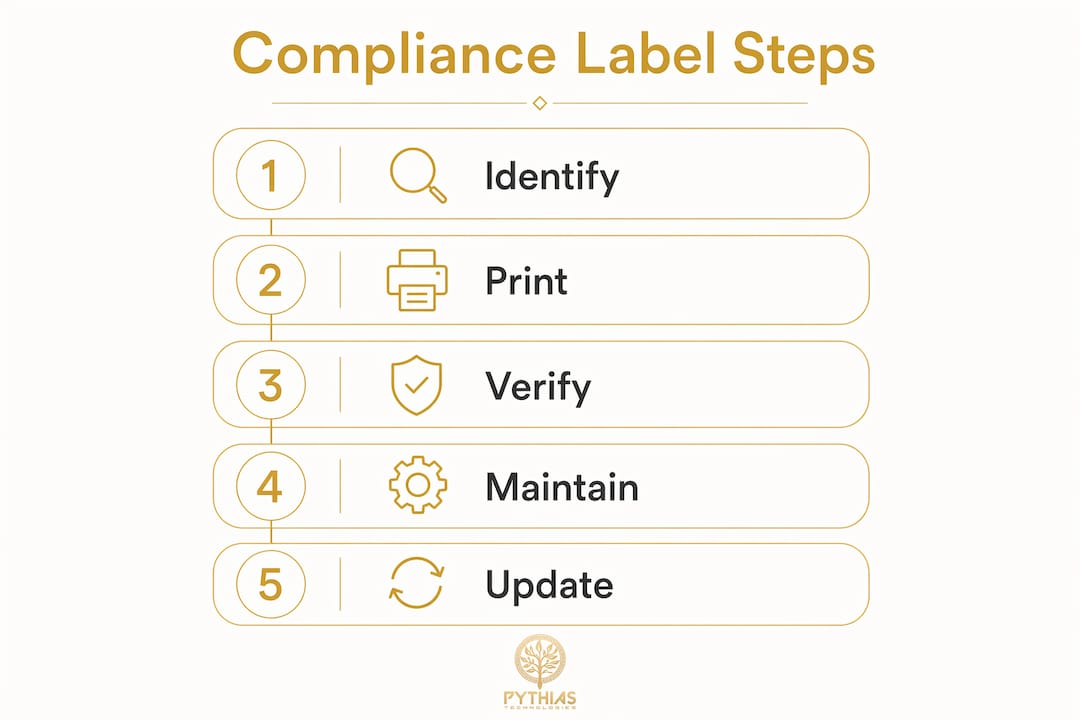
How to verify, maintain, and update label compliance over time
Compliance is not a one-time setup. Regulations change, product formulations change, and sourcing decisions change. Each of these events can invalidate a label that was accurate at launch.
The most common labeling mistake is assuming fiber content from design specs without confirming lab-tested results. Dyeing and finishing processes alter fiber composition. A blank that tests at 60% cotton before finishing may test differently after treatment. Final fiber percentages must come from lab testing, not supplier spec sheets.
A practical compliance verification workflow includes these steps:
- Test finished garments, not blanks. Submit post-production samples for fiber content testing before finalizing label copy.
- Set a label review trigger. Any change in supplier, blank SKU, ink formulation, or finishing process should automatically trigger a label review.
- Document every update. Maintain version-controlled label records with effective dates, test reports, and approval signatures.
- Monitor regulatory changes quarterly. The FTC, CPSC, and REACH each publish updates. Assign a compliance owner to track and act on changes.
- Conduct internal audits before peak seasons. Apparel printing audits before Q4 or major product launches catch errors before they reach consumers or customs.
Pro Tip: Use your production management platform to flag orders where label data has not been updated within a defined period. Pythias Fulfillment Cloud supports production reporting workflows that can be configured to alert your team when label records are stale or missing required fields.
Audit readiness requires more than accurate labels. It requires a documented chain of custody: who approved the label, what testing supported it, and when it was last reviewed. Retailers like Amazon and Walmart conduct their own supplier audits and can delist products that fail to produce this documentation on request.
Key Takeaways
Garment printing compliance labeling requires verified fiber content, durable care instructions, chemical documentation, and audit-ready records to meet FTC, CPSIA, and REACH requirements in 2026.
| Point | Details |
|---|---|
| Four mandatory label elements | Every garment needs fiber content, care instructions, country of origin, and an RN or company name. |
| Phthalate limits are enforced at customs | Plastisol inks must contain less than 0.1% phthalates; lab reports are required, not supplier claims. |
| Label durability is a legal standard | FTC requires labels to remain legible and attached for the garment’s full useful life. |
| Test finished garments, not blanks | Fiber content can shift after dyeing and finishing; only post-production lab results are legally defensible. |
| Automate compliance tracking | Production platforms that link label data to SKUs reduce manual errors and support audit readiness. |
Why compliance labeling is harder than it looks
I have reviewed compliance workflows at dozens of print shops over the years, and the same failure pattern shows up repeatedly. A shop invests in quality printing equipment, builds a solid production queue, and then treats labeling as an afterthought. The label gets copied from a supplier spec sheet, printed once, and never reviewed again. That works until a product line changes blanks, a new ink supplier comes on board, or a customs agent pulls a shipment for documentation.
The part that surprises most operators is how little margin for error exists. A label that reads “100% Cotton” when the finished garment tests at 96% cotton after finishing is a violation, even if the blank was sold to you as 100% cotton. The responsibility sits with the manufacturer of record, not the blank supplier. That is a hard lesson to learn through an FTC enforcement action.
The 2026 CPSC eFiling mandate for children’s product chemical data is the most significant regulatory shift I have seen in this space in years. It moves chemical compliance from a documentation exercise into an active digital workflow. Shops that are not already using a platform to manage compliance data will feel the pressure immediately. The good news is that tools like Pythias Fulfillment Cloud are built for exactly this kind of integrated compliance management. The technology exists. The question is whether operators adopt it before or after their first penalty.
My recommendation: treat your label data the same way you treat your order data. Version it, test it, and automate the update cycle. The shops that do this well are the ones that scale without compliance surprises.
— Michael Thero
How Pythias Technologies supports compliance labeling workflows
Managing garment printing compliance labeling across multiple SKUs, suppliers, and sales channels is a data management problem as much as a regulatory one. Pythias Technologies addresses this directly through Pythias Fulfillment Cloud and Pythias Commerce Cloud.
Pythias Fulfillment Cloud automates label and barcode printing, ties compliance documentation to each production job, and generates the production reports needed for apparel printing audits. Print shops, DTF and DTG businesses, and fulfillment providers use it to track label versions, manage ink SKU documentation, and flag orders with missing compliance data before they ship. Pythias Commerce Cloud synchronizes compliant product data across Shopify, Amazon, Etsy, Walmart, and TikTok Shop, keeping labeling requirements for clothing consistent across every channel. Explore print-on-demand fulfillment automation to see how Pythias Technologies connects compliance data to production and fulfillment in a single platform.
FAQ
What are the four required elements on a US garment label?
US law requires fiber content by percentage, permanent care instructions, country of origin, and either the manufacturer’s full name or an FTC-registered RN number. All four elements must appear on every garment sold in the US.
What is the phthalate limit for plastisol inks in 2026?
Both CPSIA and REACH enforce a limit of less than 0.1% for eight core phthalate compounds in plastisol inks. Third-party lab reports are required to document compliance; supplier claims alone do not satisfy customs requirements.
How long must a garment label remain legible?
The FTC requires that care labels remain legible and attached for the garment’s normal useful life. Heat-transfer and direct-printed labels must resist cracking, peeling, and fading through repeated wash cycles to meet this standard.
What triggers a label update requirement?
Any change in blank supplier, ink formulation, finishing process, or applicable regulation requires a label review. Fiber content can shift after dyeing and finishing, so post-production lab testing must confirm label accuracy before the updated label goes to print.
What is the 2026 CPSC eFiling mandate?
Starting July 2026, the US Consumer Product Safety Commission requires mandatory digital filing of chemical test data for children’s products. Print service providers and manufacturers supplying children’s apparel must submit this data electronically through the CPSC’s eFiling system.
Recommended
- Garment Printer Software Checklist for Print Pros | Pythias Technologies | Pythias Technologies
- Optimize Your Garment Printing Shipping Workflow | Pythias Technologies | Pythias Technologies
- Garment Print Shop Software Setup: 2026 Guide | Pythias Technologies
- Garment Printer Wholesale Pricing Best Practices | Pythias Technologies