

Selling prints is the process of offering physical or digital reproductions of your artwork or photography for purchase through online and offline channels. The global photography printing market is valued at $28 billion as of 2026, which signals a large and active buyer base ready to spend on quality prints. Platforms like Shopify, Etsy, and Saatchi Art give sellers immediate access to millions of buyers, while fulfillment automation tools like Pythias Fulfillment Cloud handle the operational side. This guide covers formats, platforms, pricing, and marketing so you can build a print business that generates consistent income.
What are the main formats and fulfillment options for selling prints?
The first decision every print seller makes is choosing between open edition and limited edition prints. Open vs. limited editions affect both pricing and sales volume in fundamentally different ways. Open editions allow unlimited copies, which suits volume-focused sellers. Limited editions restrict the number of copies, which creates scarcity and supports premium pricing for collectors.
Once you pick a format, you need a fulfillment method. Three main options exist: self-printing, local professional printing, and print-on-demand services.

| Fulfillment method | Pros | Cons | Cost profile |
|---|---|---|---|
| Self-printing | Full quality control, fast turnaround | High equipment cost, limited scale | High upfront, low per-unit |
| Local print shop | Superior quality, bulk discounts | Requires inventory investment, less flexible | Medium upfront, medium per-unit |
| Print-on-demand | No inventory, hands-off fulfillment | Inconsistent print quality risk | No upfront, higher per-unit |
Specialist print shops often deliver quality that exceeds print-on-demand, but they require you to buy and store inventory upfront. Print-on-demand services like Printful or Printify remove that barrier entirely. The trade-off is that you give up some quality control and pay more per unit.
Pro Tip: Always order samples before listing any print for sale. A product that looks sharp on screen can appear washed out or misaligned in print. Catching this before launch protects your reputation.
Which platform is right for selling art prints: marketplace or your own store?
The platform you choose determines your audience size, your brand control, and your fee structure. Marketplaces and standalone stores each serve different goals.
| Platform type | Examples | Audience | Fees | Brand control |
|---|---|---|---|---|
| Marketplace | Etsy, Saatchi Art, Fine Art America | 90+ million buyers on Etsy alone | Listing + transaction fees | Low |
| Standalone store | Shopify, Sellfy | You build your own traffic | Monthly subscription | High |
| Hybrid | Shopify + Etsy | Combined reach | Both fee structures | Medium to high |
Etsy gives you immediate access to buyers who are already searching for art and photography prints. That built-in traffic is valuable, especially for new sellers who have not yet built an audience. The downside is that Etsy controls the customer relationship and charges listing and transaction fees on every sale.
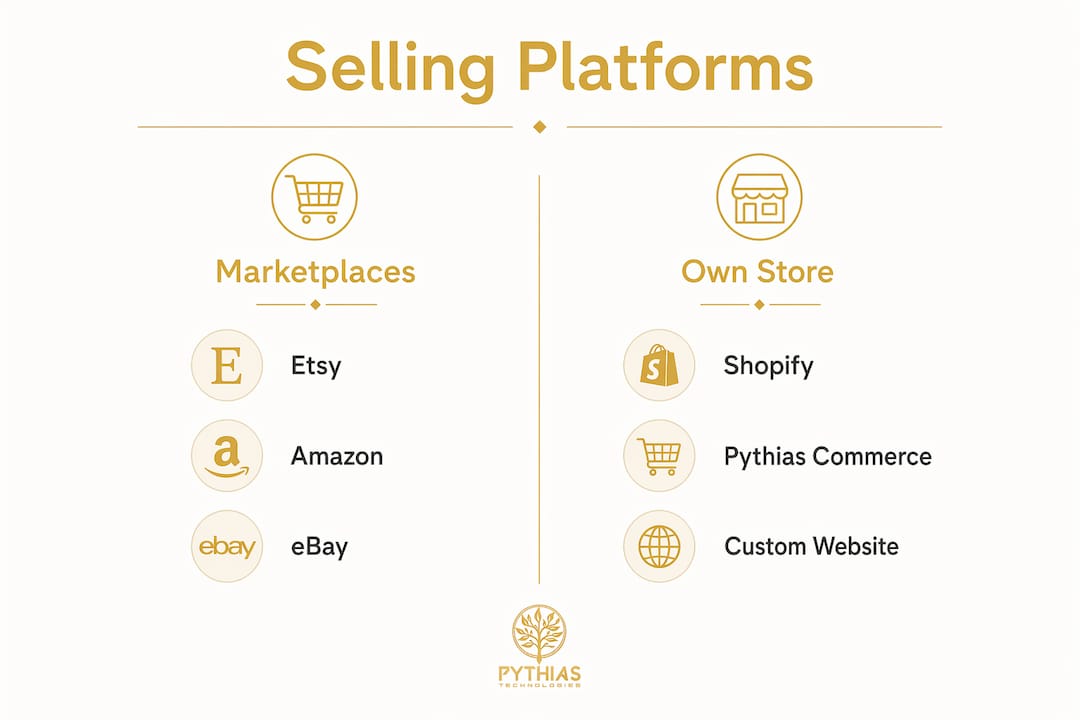
Shopify gives you full ownership of your storefront, your customer data, and your pricing. You set the rules. The challenge is that you must drive your own traffic through SEO, social media, and paid ads. Many successful sellers use a hybrid multichannel approach to reduce risk and reach different buyer segments at once.
Pythias Commerce Cloud connects your product catalog across Shopify, Etsy, Amazon, Walmart, TikTok Shop, and eBay from a single system. Orders, inventory, and listings stay synchronized automatically, which removes the manual work of managing multiple storefronts. For a detailed comparison of the two leading platforms, the Shopify vs. Etsy breakdown from Pythias Technologies covers the key differences for print sellers specifically.
Pro Tip: Start with one marketplace to generate early sales and reviews, then add your own store once you have proof of demand. Use the marketplace revenue to fund your standalone site.
How should you price your prints to stay competitive and profitable?
Effective pricing starts with a cost-plus formula. All costs, including printing, fulfillment, marketing, and platform fees, must be covered before you add your profit margin. Skipping any of these inputs leads to pricing that looks profitable but actually loses money at scale.
Open editions and limited editions require different pricing logic. Open editions compete on volume, so pricing must stay accessible while covering unit costs and leaving a reasonable margin. Limited editions command higher prices because scarcity creates collector value. A print numbered 1 of 50 carries more perceived worth than the same image available in unlimited quantities.
Common pricing mistakes to avoid:
- Underpricing to compete on cost. Buyers associate low prices with low quality, especially in the art market.
- Ignoring fulfillment costs. Shipping, packaging, and returns eat into margins fast if not calculated upfront.
- Copying competitor prices without knowing their cost structure. Their margins may be very different from yours.
- Failing to account for platform fees. Etsy charges listing fees, transaction fees, and payment processing fees on every order.
- Never revisiting prices. Material costs and shipping rates change. Review your pricing at least every six months.
Value-based pricing is the most powerful approach for established sellers. When your brand carries weight and your presentation is professional, buyers pay for the experience, not just the print. High print quality and professional presentation build perceived value and drive repeat purchases. Packaging, certificates of authenticity for limited editions, and consistent branding all contribute to what buyers are willing to pay.
How do you market and promote your prints to drive consistent sales?
Marketing is the part most sellers underinvest in. A great print with no audience generates no revenue. Building a buyer base takes consistent effort across multiple channels.
Social media is the most direct tool for print sellers. Platforms like Instagram and Pinterest are visual by nature, which makes them ideal for showcasing artwork and photography. Post regularly, include direct purchase links in your bio and stories, and show your process as well as your finished work. Behind-the-scenes content builds connection with potential buyers.
Email marketing is one of the highest-return channels available. Building a mailing list lets you promote new prints directly to people who have already expressed interest in your work. Past customers who receive a well-timed email about a new limited edition are far more likely to buy than cold social media followers.
Tactics that consistently drive print sales:
- SEO-optimized product listings. Use specific, descriptive titles and tags. “Black and white cityscape fine art print 12x16” outperforms “city photo.”
- Collaborations with other creators. Cross-promotions with artists in adjacent niches expose your work to new audiences.
- Giveaways. A well-run giveaway on Instagram or Etsy can generate hundreds of new followers and email subscribers in days.
- Art fairs and online events. Participation in curated art marketplaces and virtual events builds credibility and drives traffic back to your store.
Pro Tip: Use high-resolution mockup images that show your prints in real room settings. Buyers need to visualize the print on their wall. Lifestyle mockups consistently outperform plain white-background product shots in conversion.
Scaling your print-on-demand operations requires marketing and fulfillment to work together. As order volume grows, manual processes break down. Automating order routing, inventory updates, and shipping label generation keeps fulfillment reliable while you focus on marketing and product development.
Key takeaways
Selling prints profitably requires the right combination of format choices, platform strategy, accurate pricing, and consistent marketing.
| Point | Details |
|---|---|
| Choose your edition type first | Limited editions support premium pricing; open editions suit volume-focused sellers. |
| Match fulfillment to your scale | Print-on-demand works for beginners; specialist print shops deliver better quality at volume. |
| Use a hybrid platform approach | Combining marketplaces like Etsy with a standalone Shopify store reduces risk and widens reach. |
| Price with all costs included | Calculate printing, fulfillment, fees, and marketing before setting your margin. |
| Market consistently across channels | Email lists, social media, and SEO-optimized listings each serve different buyer segments. |
What I’ve learned from watching print sellers succeed and fail
By Michael Thero
The biggest mistake I see print sellers make is treating print-on-demand as a set-it-and-forget-it business. It is not. Print-on-demand suits passive income at lower margins, but the sellers who build real businesses combine it with limited edition drops that generate urgency and higher revenue per sale.
Quality control is where most sellers lose customers permanently. One bad print experience is enough to kill repeat business. I have seen sellers grow quickly on Etsy only to collapse under negative reviews caused by a print-on-demand partner they never vetted properly. Order samples. Test every SKU before it goes live.
Timing your sales to coincide with periods of high visibility, such as a press feature, a gallery show, or a viral social media post, can multiply your achievable price significantly. Most sellers miss this window because they are not ready to fulfill quickly. Automation tools like Pythias Fulfillment Cloud solve that problem by keeping order management and inventory tracking ready at any volume.
My honest advice: experiment with multiple platforms, commit to a marketing schedule, and automate your fulfillment before you need to. Waiting until you are overwhelmed to fix your operations costs far more than setting them up correctly from the start.
— Michael Thero
How Pythias Technologies supports growing print businesses
Print sellers who reach consistent order volume quickly find that manual fulfillment becomes the bottleneck. Pythias Technologies builds software specifically for this problem.
Pythias Commerce Cloud connects your product listings across Shopify, Etsy, Amazon, Walmart, TikTok Shop, and eBay from one central system. Inventory, orders, and product data stay synchronized across every channel automatically. Pythias Fulfillment Cloud handles production scheduling, order routing, shipping label generation, and inventory tracking for print shops and fulfillment providers. Together, the two platforms let small print businesses operate with the efficiency of much larger operations. Sellers looking to scale without adding headcount can explore print-on-demand automation software from Pythias Technologies to see how automation fits their current workflow.
FAQ
What is the best platform for selling art prints online?
Etsy offers immediate access to over 90 million buyers and works well for new sellers. Shopify gives you full brand control and customer data, making it the better long-term choice for established sellers.
Is print-on-demand worth it for selling photo prints?
Print-on-demand removes upfront inventory costs and handles fulfillment automatically, but it carries a higher per-unit cost and quality control risks. It works best as a starting point or for passive income alongside higher-margin limited edition sales.
How do I price my art prints correctly?
Start with a cost-plus formula: add up printing, fulfillment, platform fees, and marketing costs, then apply your desired profit margin. Never price below your total cost, and revisit your prices at least every six months as costs change.
What is the difference between open edition and limited edition prints?
Open editions have no copy limit and suit volume-based sales strategies. Limited editions restrict the number of copies available, which creates scarcity, supports higher pricing, and appeals to collectors.
How do I get more buyers to find my prints online?
Optimize your product listings with specific, descriptive titles and tags, build an email list of past buyers, post consistently on visual platforms like Instagram and Pinterest, and consider a hybrid approach across multiple marketplaces to maximize exposure.
Recommended
- Shopify vs Etsy for Print on Demand: Which Should You Use? | Pythias Technologies
- Print on Demand Products: Top 10 for Entrepreneurs | Pythias Technologies | Pythias Technologies
- Scaling Print on Demand Operations in 2026: A Practical Guide | Pythias Technologies
- DTG Printing Order Management for Print Shops in 2026 | Pythias Technologies | Pythias Technologies