

Print on demand (POD) is a fulfillment model where products are printed and shipped only after a customer places an order, eliminating inventory risk and upfront investment. The industry calls this model “print on demand,” though entrepreneurs searching for pods print on demand are looking for exactly the same thing: a way to sell custom products without holding stock. Platforms like Printify, Printful, and Gelato have made this accessible to anyone with a design and an internet connection. The global POD market is projected to reach $13 billion in 2026 and expand to $57 billion by 2033. That growth reflects real consumer demand for personalized products, not speculative hype.
How does the pods print on demand process work?
The POD workflow is straightforward. Each step connects automatically once you set it up correctly.
- Create your design. Use tools like Adobe Illustrator, Canva, or Affinity Designer to produce print-ready files. Most POD platforms require PNG files with transparent backgrounds at 300 DPI or higher.
- Upload to a POD platform. Platforms like Printify or Printful generate product mockups automatically. You select the product, position your design, and preview how it looks on a t-shirt, mug, or tote bag.
- List the product on your store. Connect your POD platform to Shopify, Etsy, Amazon, or WooCommerce. The listing goes live with your price, description, and mockup images.
- Customer places an order. The order routes automatically to your POD provider. No manual action required on your end.
- The provider prints, packs, and ships. Most POD providers fulfill orders within 2–5 business days and offer branded packaging options. Some providers, like ShipSage Print, complete production within 2 business days and deliver across the US within 4–6 days total.
- You collect your profit. Your profit equals your retail price minus the base product cost and any platform fees. There are no inventory costs to subtract.
Pro Tip: Set your retail price at least 2.5x the base cost. This covers platform fees, ad spend, and returns while keeping a healthy margin.
The entire cycle runs without you touching a single product. That is the core advantage of the POD model for entrepreneurs who want to test ideas before committing capital.

Which POD platforms are worth using in 2026?
Choosing the right platform affects your margins, product quality, and customer experience. The four platforms entrepreneurs use most are Printify, Printful, Gelato, and Gooten.
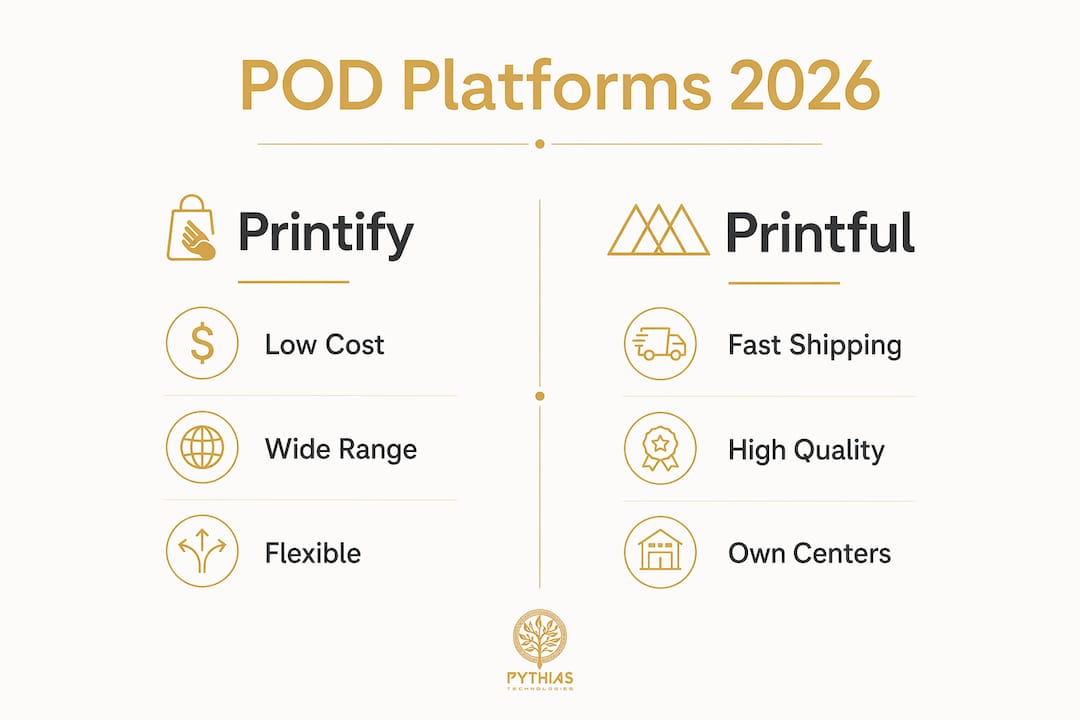
| Platform | Base cost | Product variety | Fulfillment speed | Best for |
|---|---|---|---|---|
| Printify | Low | Very wide | Varies by printer | Cost-conscious testing |
| Printful | Higher | Wide | Consistent, fast | Quality-focused scaling |
| Gelato | Moderate | Wide | Fast, global network | International sellers |
| Gooten | Moderate | Wide | Varies | Multi-product catalogs |
Printful operates its own fulfillment centers, which produces faster shipping and more consistent quality, but at 15–30% higher cost than Printify. Printify uses a network of third-party print providers, which lowers base costs but introduces variability in quality and turnaround time.
The practical recommendation is clear: start with Printify on a free plan to minimize upfront costs and validate your niche. Migrate to Printful as your volume grows and quality consistency becomes a priority. Gelato is the strongest option for entrepreneurs targeting customers in Europe or Australia, since it fulfills locally and cuts international shipping costs significantly.
Key factors to evaluate when selecting a platform:
- Integration support. Printify and Printful both connect natively to Shopify, Etsy, WooCommerce, and Amazon.
- Custom branding. Printful offers custom neck labels, pack-ins, and branded packaging. Printify’s branding options depend on the individual print provider.
- Product catalog depth. Printify carries over 900 products. Printful’s catalog is smaller but more curated.
- Sample ordering. Both platforms let you order samples at a discount before going live.
What technologies power POD automation and scaling?
Automation separates a hobby store from a real business. The right software stack handles order routing, inventory syncing, and production tracking without manual intervention.
The core technology layer for any growing POD operation includes:
- Order management systems. Platforms like Pythias Fulfillment Cloud automate production scheduling, barcode scanning, shipping label generation, and warehouse operations. This removes the manual bottlenecks that slow fulfillment as order volume grows.
- API integrations. Connecting your Shopify or Etsy store to your POD provider via API means orders flow automatically. No copy-pasting order details. No missed shipments.
- Multichannel listing tools. Pythias Commerce Cloud lets you publish product listings across Shopify, Etsy, Amazon, Walmart, TikTok Shop, and eBay from one central system. Inventory and order data sync in real time across all channels.
- Shipping carrier integration. Automated label generation and carrier selection reduce fulfillment time and shipping errors. Pythias Fulfillment Cloud supports multi-channel sales, inventory syncing, and automated print fulfillment management in a single platform.
- Production workflow software. Printing workflow tools manage print queues, track job status, and generate production reports. This is critical for DTG and DTF businesses handling high order volumes.
Pro Tip: Connect all your sales channels to one order management system before you scale. Fixing fragmented workflows at 500 orders per month is far harder than building them correctly at 50.
The entrepreneurs who scale POD businesses past the hobby stage treat technology as infrastructure, not an afterthought. Automation reduces errors, speeds up fulfillment, and frees up time for design and marketing work.
Which products and niches offer the best POD opportunities?
The POD market rewards specificity. Broad stores selling generic designs compete on price and lose. Niche stores with targeted designs command higher prices and build loyal audiences.
The top-performing product categories in 2026 are:
- Apparel. T-shirts, hoodies, and sweatshirts remain the highest-volume POD category. DTG printing on Bella+Canvas and Gildan blanks dominates this space.
- Drinkware. Mugs, tumblers, and water bottles carry strong margins and gift-purchase behavior. Sublimation printing produces vibrant, durable results on these items.
- Accessories. Phone cases, tote bags, and hats have lower base costs and appeal to impulse buyers.
- Home goods. Throw pillows, blankets, and wall art attract higher average order values and repeat buyers decorating their spaces.
- Stationery and journals. Notebooks and planners with niche-specific designs sell well on Etsy to organized and creative communities.
For a deeper breakdown of which products convert best, the top 10 POD products for entrepreneurs analysis covers margins, competition levels, and platform fit.
Profitable niches share three traits: passionate communities, specific visual identities, and underserved product selections. Examples include hiking dog owners, vintage truck collectors, and teachers by subject area. Each of these groups buys merchandise that reflects their identity. A generic “dog lover” store competes with thousands of sellers. A “golden retriever hiking” store competes with far fewer and converts at a higher rate.
Niche research tools like Google Trends, Etsy search autocomplete, and Merch Informer reveal what buyers are actively searching for. Run trademark checks on every phrase using the USPTO database before printing. Using a trademarked phrase on a product gets your store suspended, not just the listing.
What are the most common POD startup mistakes and how to avoid them?
Most POD businesses fail not because the model is flawed, but because failures come from discipline gaps, not the POD model itself. Consistent research and optimization drive success.
- Skipping test orders. Placing test orders is non-negotiable for verifying print quality, color accuracy, and packaging before going live. A design that looks sharp on screen can print muddy or off-color on fabric. Order samples of every product you plan to sell.
- Ignoring SEO on listings. Etsy and Amazon are search engines. Listings without keyword-optimized titles, tags, and descriptions get no organic traffic. Research buyer search terms and write listings that match them.
- Using trademarked phrases. Phrases like “This Is Us,” sports team names, and character names are protected. Using them triggers DMCA takedowns and account bans. Check every phrase before uploading.
- Expecting fast income. Most POD stores take 3–6 months to generate consistent revenue. Treat the first 90 days as market research, not income generation.
- Uploading once and stopping. Success requires consistent design uploads, SEO-optimized listings, and ongoing content creation. Stores that upload 10 designs and wait do not grow.
Pro Tip: Build a content calendar for design uploads. Committing to 5 new designs per week for 6 months produces a catalog large enough to generate meaningful organic traffic.
Customer service also matters more than most new sellers expect. Fast, polite responses to complaints and proactive shipping updates build the review scores that drive long-term Etsy and Amazon rankings. Treat every customer interaction as a branding decision.
Key takeaways
Print on demand is a proven, low-risk business model, but success requires platform selection, automation infrastructure, niche discipline, and consistent execution over months, not days.
| Point | Details |
|---|---|
| Start with Printify | Use the free plan to test niches before committing to higher-cost platforms. |
| Automate order management | Connect all sales channels to one system like Pythias Fulfillment Cloud before scaling. |
| Order test samples | Verify print quality and color accuracy on every product before going live. |
| Niche down specifically | Target passionate communities with specific designs, not broad audiences with generic art. |
| Check trademarks first | Run every phrase through the USPTO database to avoid account bans and DMCA takedowns. |
Why discipline beats platform choice every time
I have watched hundreds of entrepreneurs pick the “wrong” platform and still build six-figure POD stores. I have also watched people on the “right” platform fail within 90 days. The variable that actually predicts success is not Printify versus Printful. It is whether the entrepreneur treats POD like a research-intensive business or a passive income shortcut.
The low barrier to entry is both the model’s strength and its trap. Because anyone can start, most people do not take it seriously enough. They upload 15 designs, run no ads, write no SEO copy, and wonder why nothing sells. The stores that grow are the ones run by people who study their niche weekly, test new designs systematically, and treat customer feedback as product development data.
Automation technology like Pythias Fulfillment Cloud matters enormously once you have volume. But volume only comes after you have done the unglamorous work of niche research, listing optimization, and consistent uploads. The technology layer accelerates a working business. It does not fix a broken one.
The future of POD is distributed fulfillment and AI-powered order routing. Platforms that connect sellers to regional print providers based on capacity and location will cut shipping times and costs significantly. Entrepreneurs who build their operations on integrated platforms now will be positioned to plug into that network as it matures. The market opportunity is real. The work required to capture it is equally real.
— Michael Thero
How Pythias Technologies supports your POD operation
Pythias Technologies builds the software infrastructure that POD businesses need to move from manual processes to automated operations.
Pythias Fulfillment Cloud manages production scheduling, order routing, barcode scanning, shipping label generation, and inventory tracking in one system. Pythias Commerce Cloud connects your product catalog to Shopify, Etsy, Amazon, Walmart, TikTok Shop, and eBay, syncing orders and inventory in real time. Together, they replace the spreadsheets and manual handoffs that slow growing POD businesses down. Entrepreneurs ready to build a real operational foundation can explore POD fulfillment automation or review how the platform works to see where it fits their current workflow.
FAQ
What is print on demand and how does it work?
Print on demand is a fulfillment model where products are printed only after a customer orders them. The seller uploads a design, lists the product, and the POD provider handles printing, packaging, and shipping automatically.
How long does POD fulfillment take?
Most POD providers fulfill orders within 2–5 business days. Some US-based providers complete production in 2 business days and deliver within 4–6 days total.
Which POD platform is best for beginners?
Printify is the best starting point for most entrepreneurs because its free plan minimizes upfront costs. Migrate to Printful when consistent quality and faster shipping become priorities.
Do I need inventory to start a POD business?
No. POD requires zero inventory. Products are printed on demand, so you pay the base cost only after a customer pays you first.
What software helps scale a POD business?
Order management platforms like Pythias Fulfillment Cloud automate production scheduling, shipping, and inventory tracking. Pythias Commerce Cloud handles multichannel listing and order syncing across Shopify, Etsy, Amazon, and other marketplaces.
Recommended
- Print on Demand Products: Top 10 for Entrepreneurs | Pythias Technologies | Pythias Technologies
- Scaling Print on Demand Operations in 2026: A Practical Guide | Pythias Technologies
- Software for Print on Demand Businesses — Fulfillment Automation | Pythias | Pythias Technologies
- Types of Print on Demand Integrations for Entrepreneurs | Pythias Technologies