

Order routing in print-on-demand (POD) is the automated process that determines which fulfillment location receives each customer order, based on real-time inventory, shipping costs, and customer proximity. Understanding how order routing works in POD operations is the difference between a fulfillment process that scales and one that breaks under volume. The mechanics involve an order management system (OMS) evaluating multiple variables in milliseconds, then assigning the order to the most cost-effective and geographically optimal production partner or warehouse. Get this right, and you reduce shipping costs, cut transit times, and keep customers satisfied across every sales channel.
How does the order routing process function step-by-step in POD?
Order routing is an automated OMS process that evaluates inventory, proximity, and shipping costs to assign orders to optimal fulfillment locations in milliseconds. That speed matters because manual routing at any meaningful order volume creates bottlenecks that compound daily.
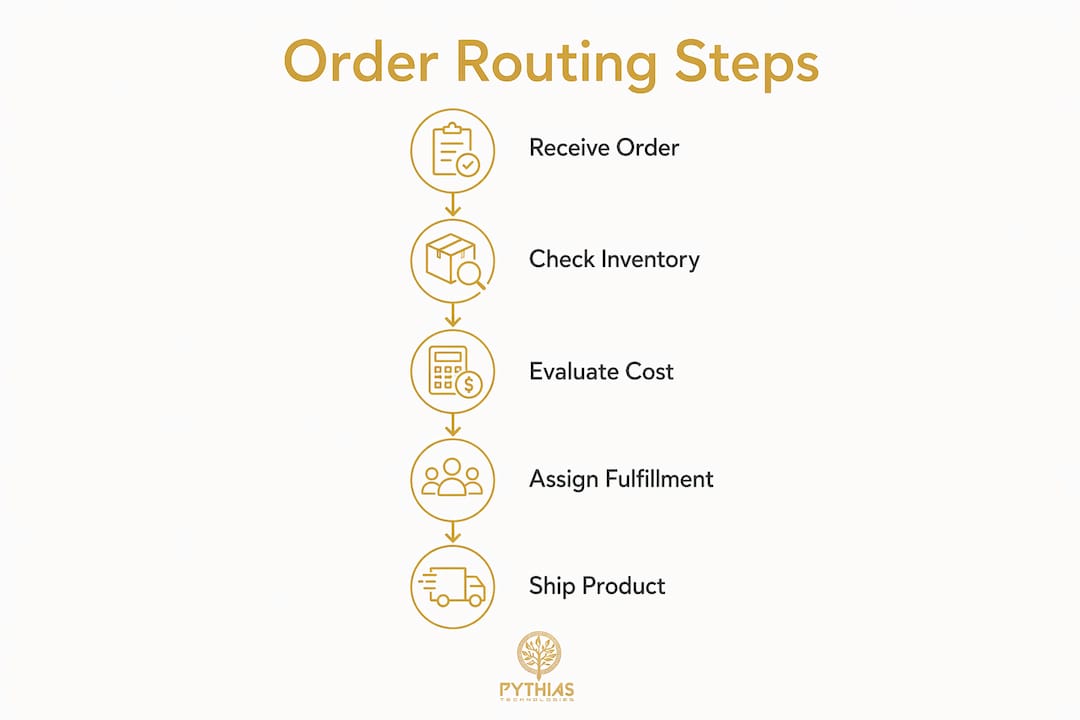
The pod order routing process follows a clear sequence:
- Order received. The OMS captures the order from your sales channel, whether that is Shopify, Etsy, Amazon, or Walmart.
- Inventory check. The system queries real-time stock levels across all connected fulfillment locations. A DTF print shop in Texas and an embroidery facility in Ohio may both carry the same blank SKU.
- Proximity calculation. The routing engine maps the customer’s shipping address against available fulfillment nodes. Shorter distances mean fewer shipping zones crossed.
- Cost evaluation. Routing priority focuses on minimizing shipping zones, which directly lowers logistics costs while still meeting delivery speed targets. Dimensional weight (DIM weight) and carrier rate tables factor into this calculation.
- Assignment decision. The system selects the fulfillment location that satisfies inventory availability, proximity, and cost thresholds simultaneously.
- Production trigger. The order enters the production queue at the assigned location, and a shipping label is generated automatically.
A practical example: a customer in Atlanta orders a custom hoodie. Your routing engine checks inventory at your Georgia print shop and your Chicago DTG facility. Both have stock. The Georgia location wins because it crosses fewer shipping zones, cutting your carrier cost and delivering the package a day faster.
Pro Tip: Configure your routing engine to evaluate carrier performance scores alongside cost. A carrier with a lower rate but a higher late-delivery rate can cost more in customer service time than the savings justify.

What are the common challenges in POD order routing?
The pod order routing process gets complicated fast when inventory is distributed, orders are high-volume, or products span multiple production methods like DTG, embroidery, and DTF.
Split shipments are the most common friction point. When a customer orders two items and only one is available at the nearest fulfillment location, the routing engine must decide whether to split the order into two shipments or hold it until a single location can fulfill both. Routing logic must handle split shipments cost-effectively and include fallback rules when inventory is unavailable. Without that logic, orders either delay or ship in two packages at double the freight cost.
Order holds are another layer of complexity that many POD entrepreneurs underestimate. Order holds pause fulfillment for validations like fraud review, address confirmation, or credit checks. Skipping these holds to speed up routing creates silent failures: orders shipped to unverified addresses, fraudulent transactions fulfilled before detection, and compliance gaps that carry real financial risk.
Process drift is the subtler threat. Misalignment between OMS routing logic and warehouse execution causes fulfillment errors that are hard to trace. A routing rule says “assign to Facility A,” but a warehouse team member manually overrides it for convenience. Over time, those overrides accumulate and your routing data no longer reflects reality.
Best practices to address these challenges:
- Define explicit fallback rules for every out-of-stock scenario before you go live.
- Set order hold triggers for address validation and fraud scoring at the OMS level, not manually.
- Audit routing overrides weekly and retrain warehouse staff when drift appears.
- Document every routing rule in a standard operating procedure (SOP) so new team members execute consistently.
Pro Tip: Treat your routing SOP as a living document. Review it every quarter and update it whenever you add a new fulfillment location, carrier, or product category.
How can POD entrepreneurs build and optimize their routing logic?
Building effective order routing logic starts with six foundational configuration steps. Effective routing systems define inventory positions, address types, DIM weights, carrier logic, SLAs, and SOP documentation before any order flows through the system. Skipping any of these steps creates cost leakages that are difficult to diagnose later.
The table below outlines the core configuration areas and what each one controls:
| Configuration Area | What It Controls |
|---|---|
| Inventory positions | Which SKUs are available at each fulfillment node |
| Address types | Residential vs. commercial delivery rate differences |
| DIM weight rules | Carrier cost calculations for oversized or lightweight packages |
| Carrier logic | Which carriers are eligible per zone, speed tier, or product type |
| Service level agreements (SLAs) | Maximum transit time commitments per sales channel |
| SOP documentation | Written rules governing manual overrides and exception handling |
Once the foundation is set, you can layer in dynamic routing rules. For example, Etsy orders might route to your nearest small-batch print shop, while Amazon orders with Prime SLAs route to your highest-capacity DTG facility regardless of distance. Routing by sales channel, product category, or customer segment gives you precise control over cost and delivery performance.
Integration with an order management system is non-negotiable at scale. Platforms like Pythias Fulfillment Cloud connect inventory data, production queues, and carrier rate tables into a single routing engine. That integration eliminates the manual data entry that causes routing errors in disconnected systems.
Routing rules and execution must be auditable to support compliance and continuous improvement. The metrics worth tracking include: order assignment accuracy rate, average shipping zone per order, split shipment rate, and SLA compliance percentage. These four numbers tell you whether your routing logic is working or drifting.
What role does smart order routing play in POD fulfillment automation?
Smart order routing (SOR) is a more advanced form of the pod order routing process. Where basic rule-based routing follows static if-then logic, SOR uses real-time data to make dynamic decisions that adapt to changing conditions.
Smart order routing uses real-time market intelligence including inventory levels, carrier latency, and fulfillment capacity to allocate orders dynamically for cost and speed. That means a routing engine running SOR logic can detect that your primary fulfillment node is at 95% capacity and automatically redirect overflow to a secondary location without any manual intervention.
The most powerful feature of SOR in POD operations is order slicing. Smart routing engines create child orders from a parent order to allocate portions to multiple fulfillment locations, maximizing fill rates. A five-item order might split into three child orders, each routed to the location with the relevant inventory, then consolidated for shipping where carrier rates allow.
Key benefits of smart order routing for POD businesses:
- Higher fill rates. Orders that would fail at a single location succeed when split intelligently across your fulfillment network.
- Lower shipping costs. Dynamic zone minimization outperforms static rules under fluctuating inventory conditions.
- Faster delivery times. Real-time carrier performance data routes away from delayed carriers automatically.
- Reduced manual intervention. Automated fallback logic handles exceptions without requiring a team member to intervene.
“Automated intelligent decisions outperform static rule-based routing under fluctuating conditions.” — Smart Order Routing research, Quod Financial
Pythias Commerce Cloud connects your product catalog and marketplace listings across Shopify, Etsy, Amazon, Walmart, TikTok Shop, and eBay, while Pythias Fulfillment Cloud handles the production scheduling, inventory tracking, and shipping carrier integration that SOR depends on. Together, they give POD entrepreneurs the infrastructure to run intelligent routing without building custom software.
Key takeaways
Order routing in POD is the automated assignment of each customer order to the optimal fulfillment location based on inventory, proximity, carrier cost, and SLA requirements, and getting it right is the foundation of scalable fulfillment.
| Point | Details |
|---|---|
| Routing is automated and fast | An OMS evaluates inventory, proximity, and cost in milliseconds to assign each order. |
| Cost optimization drives routing priority | Minimizing shipping zones crossed reduces logistics costs and improves delivery speed. |
| Fallback rules prevent order failures | Define explicit fallback logic for out-of-stock scenarios before going live. |
| Process drift erodes routing accuracy | Audit routing overrides weekly and enforce SOPs to keep logic aligned with execution. |
| Smart routing increases fill rates | SOR splits orders into child orders across multiple locations to maximize fulfillment success. |
Why routing logic is the most underrated lever in POD growth
I have worked with enough POD operations to say this plainly: most entrepreneurs treat order routing as a setup task rather than an ongoing discipline. They configure their OMS once, assume it works, and move on. That assumption is where growth stalls.
The businesses I have seen scale past 10,000 monthly orders without adding headcount all share one trait. They treat their routing logic as a product. They review it on a schedule, test new rules against historical data, and document every change. When a new fulfillment partner comes online or a carrier raises rates in a specific zone, their routing adapts within days, not months.
The other pattern I keep seeing is underinvestment in fallback rules. Entrepreneurs spend hours configuring the primary routing path and zero time on what happens when that path fails. A single out-of-stock event without a fallback rule can cascade into dozens of delayed orders and a wave of customer service tickets.
My honest recommendation: before you add another sales channel or fulfillment partner, audit your existing routing logic first. Map every rule, test every fallback, and confirm that your OMS data matches your actual warehouse inventory. That audit will surface more growth capacity than any new channel will deliver in the short term.
— Michael Thero
Pythias Technologies: built for POD order routing at scale
POD entrepreneurs who want to automate their fulfillment without building custom routing logic have a direct path forward with Pythias Technologies.
Pythias Fulfillment Cloud automates production scheduling, inventory tracking, and shipping label generation across your entire fulfillment network. Pythias Commerce Cloud syncs orders and inventory across 18+ marketplaces in real time, giving your routing engine accurate data to work with at every decision point. Together, they form the infrastructure that print-on-demand businesses need to run intelligent, distributed fulfillment without manual intervention. Whether you operate a single DTG shop or a network of fulfillment partners, Pythias Technologies connects every node into one system. Book a demo to see the routing engine in action.
FAQ
What is order routing in print-on-demand?
Order routing in POD is the automated process of assigning each customer order to the most suitable fulfillment location based on inventory availability, customer proximity, and shipping cost. The OMS executes this decision in milliseconds without manual input.
How does split shipment routing work in POD?
Smart order routing engines create child orders from a single parent order, allocating each portion to a different fulfillment location based on available inventory. This approach maximizes fill rates and avoids order delays when no single location holds all items.
What causes process drift in order routing?
Process drift occurs when warehouse teams manually override OMS routing decisions, causing the actual fulfillment execution to diverge from the configured logic. Regular SOP audits and override tracking prevent drift from compounding into systemic errors.
Why do order holds matter in a routing system?
Order holds pause fulfillment to complete fraud checks, address validation, or credit verification before production begins. Skipping holds increases the risk of shipping to invalid addresses or fulfilling fraudulent transactions at full cost.
What metrics should I track to evaluate routing performance?
Track order assignment accuracy rate, average shipping zones per order, split shipment rate, and SLA compliance percentage. These four metrics reveal whether your routing logic is performing as configured or drifting over time.
Recommended
- POD Order Tracking Automation: A 2026 How-To Guide | Pythias Technologies
- Order Management Software for Ecommerce — Multichannel OMS | Pythias | Pythias Technologies
- The Role of Shipping Carrier Integration in Printing | Pythias Technologies
- POD Metrics That Matter: On-Time, Channels, Reorders | Pythias Technologies