

Most logistics managers treat shipping manifests as a compliance checkbox. Fill in the fields, submit on time, move on. But the role of automated shipping manifests has shifted dramatically. These documents are now the data backbone of your entire shipping operation, feeding customs systems, triggering risk assessments, and determining whether your cargo clears in hours or sits for days. If you are still running manual manifest processes, you are leaving money, time, and compliance certainty on the table.
Table of Contents
- Key takeaways
- The role of automated shipping manifests explained
- Benefits of automated manifests for shipping operations
- Challenges and how to overcome them
- Compliance requirements and filing timelines
- Implementing automated manifests: practical steps
- My take on where manifest automation is actually heading
- How Pythiastechnologies supports your automation goals
- FAQ
Key takeaways
| Point | Details |
|---|---|
| Automation reduces port delays | Automated manifest data cuts clearance times by 40%, directly improving trade efficiency. |
| Errors carry real costs | Manifest discrepancies cause holds of 5 to 7 days with combined fees reaching $1,000 to $3,000 or more. |
| CBP requires 24-hour filing | Electronic export manifests must be transmitted at least 24 hours before cargo loading under CBP mandates. |
| Human oversight still matters | Automation handles volume, but human review remains critical for high-value shipments and subtle data mismatches. |
| Implementation requires clean data | Automation only performs as well as the source data feeding it. Data governance is non-negotiable. |
The role of automated shipping manifests explained
A shipping manifest is a master document listing every item aboard a vessel, aircraft, or truck. It includes cargo descriptions, weights, consignee details, HS codes, and carrier information. Customs authorities, port operators, and carriers all rely on it to verify cargo, assess risk, and release shipments.
Traditional manifests were paper-based or entered manually into disconnected systems. Errors were common, submissions were late, and corrections required phone calls and faxes. Automated manifests replace that process entirely.
How automation changes the process:
- Data is pulled directly from order management, warehouse, and ERP systems
- Manifests are generated and submitted electronically without manual re-entry
- Systems like the Automated Manifest System (AMS) and ACE (Automated Commercial Environment) receive and process filings in real time
- Errors trigger alerts before submission, not after customs flags them
Two terms you will encounter regularly: the Electronic Export Manifest (EEM), which covers outbound vessel cargo, and the Importer Security Filing (ISF), which requires advance cargo data for inbound ocean shipments. Both operate through automated data exchange between carriers, freight forwarders, and CBP.
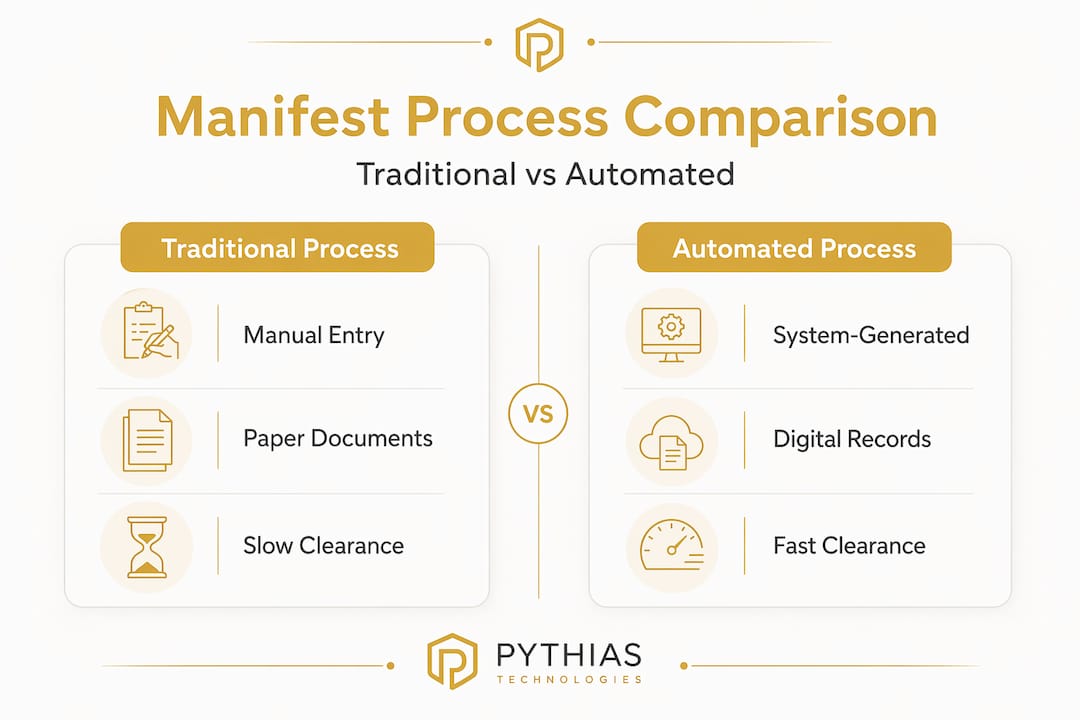
Automated vs. traditional manifest processes:
| Factor | Traditional process | Automated process |
|---|---|---|
| Data entry | Manual, error-prone | System-generated from source data |
| Submission timing | Often late or batch-filed | Real-time or scheduled electronic filing |
| Error detection | Post-submission, by customs | Pre-submission validation alerts |
| Compliance tracking | Manual logs | Automated audit trails |
| Cost of errors | $150 to $500+ per container | Significantly reduced with validation |
Benefits of automated manifests for shipping operations
The operational advantages of automated shipping processes go well beyond saving time on paperwork. They touch compliance, cost, security, and the speed at which your cargo moves through ports.
Accurate documentation reduces port dwell time by 62%. That is not a marginal improvement. For high-volume operations, that difference compounds across hundreds of shipments per month.
Core benefits logistics teams see immediately:
- Accuracy gains. Weight discrepancies over 5% trigger physical inspections in 78% of cases. Automated systems pull weight data directly from warehouse records, eliminating manual transcription errors.
- Faster customs clearance. Early electronic submission allows CBP’s Automated Targeting System (ATS) to pre-screen cargo, so compliant shipments clear without delay.
- Labor savings. High-volume shippers processing 1,000 orders per day saved 25 hours daily by automating rate shopping and manifest generation. Each manual comparison previously took roughly 90 seconds.
- Compliance enforcement. Automated systems apply rule-based logic consistently, so filing deadlines and required fields are never missed.
- Financial accuracy. Automated matching of Export General Manifests (EGM) is critical for timely export incentive refunds and duty drawback processing. Errors here cost money beyond just port fees.
The security dimension is equally significant. Early electronic manifest submission improves cargo targeting and security screening, minimizing trade disruptions that affect your entire supply chain.
Pro Tip: Run a 30-day audit of your current manifest error rate before switching platforms. That baseline number becomes your ROI benchmark after implementation.
Challenges and how to overcome them
Automation does not eliminate manifest problems. It changes where they occur and how you manage them. Understanding this distinction is what separates teams that get full value from automation and those that just move their errors upstream.
The most common issues in automated logistics documentation fall into three categories:
- Data mismatches at the source. If your warehouse system records weights differently than your order management platform, the manifest will reflect that conflict. The automation did not create the problem. It just surfaced it faster.
- Incomplete fields from upstream systems. Missing consignee data or incorrect HS codes cause 3 to 7 day delays and fees between $150 and $500 per container. Automated systems need complete, validated inputs to generate compliant outputs.
- Late submissions from integration failures. API timeouts, system outages, or misconfigured triggers can cause a manifest to miss its filing window. A 24-hour deadline has no grace period for technical excuses.
Manifest errors lead to 5 to 7 day holds with combined fees exceeding $1,000 to $3,000 per incident. Those costs compound when you add detention, storage, and re-stuffing fees that layer on top of each other.
Human oversight remains critical for detecting subtle discrepancies that automated systems miss, particularly for high-value or regulated shipments. Automation handles volume. Experienced staff handle judgment.
Pro Tip: Assign a dedicated exception queue owner. Automated systems route discrepancies to manual review, but someone needs to own that queue daily. Without clear ownership, exceptions pile up and deadlines slip.
One often-overlooked risk: errors in vessel identification data, such as confusing IMO with MMSI numbers, can compromise tracking and compliance audits in automated systems. Vessel ID validation should be part of your pre-submission checks.
Compliance requirements and filing timelines
Understanding the regulatory framework is not optional for logistics managers. CBP mandates are specific, and the consequences of non-compliance are immediate and costly.
| Requirement | Detail | Responsible party |
|---|---|---|
| Electronic export manifest (EEM) | Must be transmitted 24 hours before loading | Carrier or authorized agent |
| Importer Security Filing (ISF) | 24 hours before vessel departure from foreign port | Importer or licensed customs broker |
| Two-hour exception rule | Applies to short-sea voyages under specific CBP criteria | Carrier |
| ATS integration | Manifest data feeds CBP’s Automated Targeting System for risk scoring | Carrier via AMS |
| Non-compliance penalties | Late or missing filings trigger holds, fines, and increased inspection rates | Carrier, NVOCC, freight forwarder |
NVOCCs (Non-Vessel Operating Common Carriers) and freight forwarders share responsibility for accurate data submission alongside carriers. If your forwarder submits incorrect data, your cargo pays the price.
Globally, regulatory harmonization is accelerating. Customs authorities in the EU, Asia-Pacific, and Latin America are adopting electronic manifest requirements modeled on CBP’s framework. If your operation is international, the compliance burden is expanding, not shrinking. Building automated logistics documentation practices now positions your team ahead of those requirements.
Implementing automated manifests: practical steps
Selecting a platform is the smallest part of implementation. The real work is in data governance, system integration, and staff alignment.
Step-by-step implementation framework:
- Audit your current data sources. Map every system that feeds manifest data: WMS, OMS, ERP, carrier portals. Identify where data is duplicated, inconsistent, or manually entered.
- Define data ownership. Assign clear responsibility for each data field. Who owns consignee data? Who validates HS codes? Ambiguity here is the root cause of most manifest errors.
- Select a platform with pre-built integrations. Look for direct connections to AMS, ACE, and your existing logistics systems. Custom integrations add cost and maintenance overhead.
- Configure validation rules before go-live. Set up pre-submission checks for required fields, weight thresholds, and filing deadlines. Catching errors before submission is always cheaper than correcting them after.
- Train staff on exception management. Automation handles routine filings. Your team needs to be skilled at managing the exceptions the system flags, not just operating the software.
- Build a reporting dashboard. Track error rates, clearance times, and exception volumes weekly. Manifest data is also a source of operational intelligence: patterns in delays or discrepancies often point to upstream process failures.
Efficient shipping management at scale requires treating manifest automation as an ongoing process, not a one-time implementation. Systems need maintenance, rules need updating as regulations change, and staff need regular refreshers as platforms evolve.
My take on where manifest automation is actually heading
I have watched logistics teams implement manifest automation and assume the hard work is done once the system is live. That is the wrong frame. What I have learned from working with high-volume shipping operations is that automation shifts the problem, it does not eliminate it.
The most underappreciated shift is that automated manifests now function as exception engines. Discrepancies surface faster and get routed to review queues automatically. That is genuinely useful. But it means your team needs sharper exception-handling skills, not fewer people who understand the data.
What I find most interesting right now is the emergence of agentic AI in this space. AI-enabled systems launched in 2026 allow logistics teams to automate exception handling itself, not just manifest generation. That changes staffing calculus significantly. The question is no longer “how many people do we need to file manifests?” It is “how many people do we need to supervise AI agents managing exceptions?”
My honest advice: do not implement AI-driven exception management until your base data quality is clean. AI agents managing bad data will automate your errors at scale. Get the fundamentals right first.
The impact of technology on shipping is real and accelerating. But the teams that benefit most are the ones that treat automation as a tool requiring skilled operators, not a replacement for operational judgment.
— Michael
How Pythiastechnologies supports your automation goals

Pythiastechnologies builds automation platforms designed for operations where data accuracy and workflow speed are non-negotiable. The platform connects design management, inventory tracking, order processing, and shipping workflows in a single environment, so the data feeding your manifests is consistent, validated, and current.
For logistics managers and shipping coordinators, that means fewer manual touchpoints between your order data and your manifest submissions. Batch processing, real-time inventory updates, and integrated reporting give your team the visibility to catch discrepancies before they become customs holds.
Explore the full platform capabilities or review available services to see how Pythiastechnologies fits your current workflow. Ready to see it in action? Book a demo with the team today.
FAQ
What is the role of automated shipping manifests?
Automated shipping manifests generate, validate, and submit cargo documentation electronically, feeding customs systems like AMS and ACE in real time. They reduce manual errors, speed up customs clearance, and support compliance with CBP filing requirements.
How early must an electronic export manifest be filed?
CBP mandates electronic export manifest transmission at least 24 hours before cargo is loaded onto a vessel. Short-sea voyages may qualify for a two-hour exception under specific criteria.
What are the costs of manifest errors?
Manifest discrepancies can cause 5 to 7 day customs holds with combined fees of $1,000 to $3,000 or more per incident, plus additional detention and storage charges that compound quickly.
Do automated manifests eliminate the need for human review?
No. Automated systems handle volume and flag discrepancies, but human oversight remains critical for high-value shipments, subtle data mismatches, and managing exception queues that require judgment.
What data is required for an accurate shipping manifest?
A complete manifest requires accurate cargo descriptions, HS codes, consignee details, vessel identification numbers, and verified weights. Missing or incorrect HS codes alone cause 3 to 7 day delays and fees of $150 to $500 per container.