
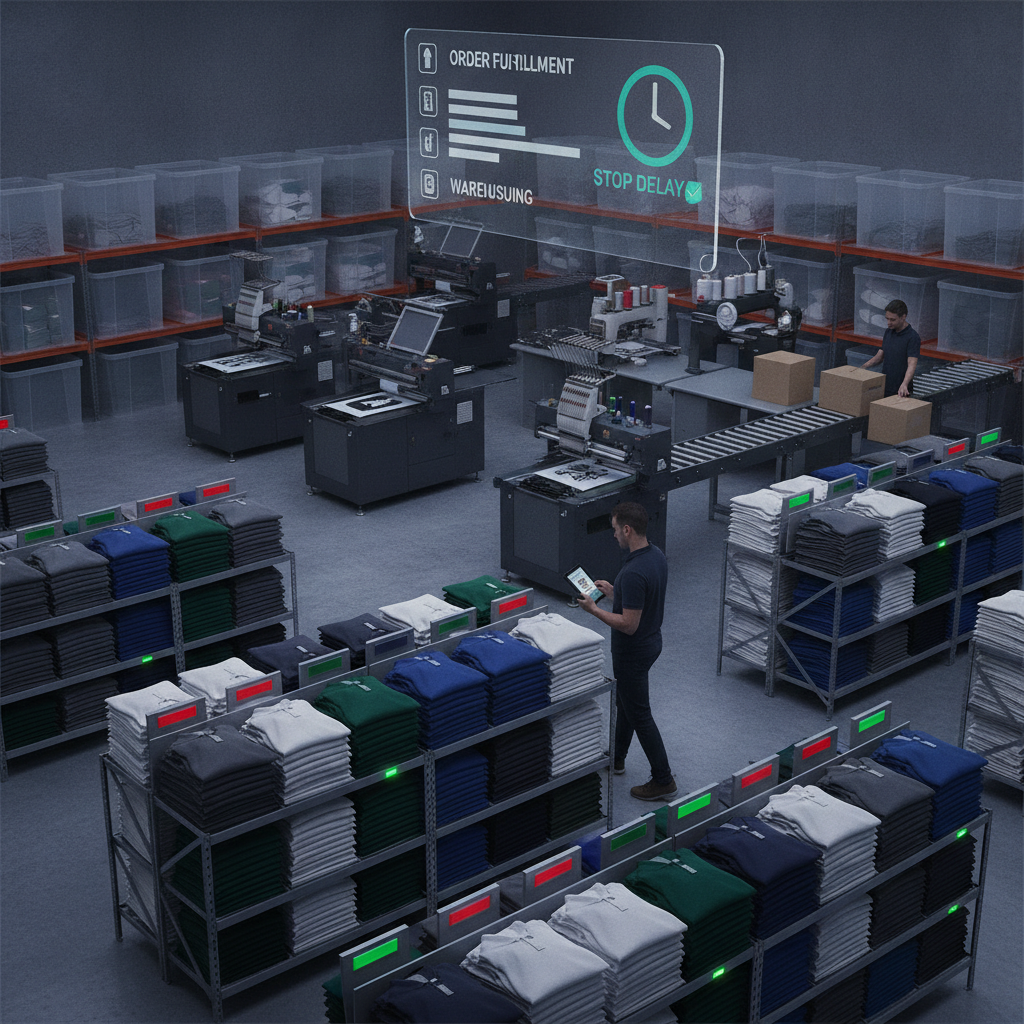
For a print shop, the fastest way to blow a turnaround promise isn't a slow printer or a busy day — it's discovering you're out of a heather gray 2XL the moment an order hits the queue. Inventory shortfalls don't announce themselves at the SKU level you actually pull from. They hide inside a single color and size combination, and they surface at the worst possible time: mid-production.
This is why tracking blanks the way you actually use them — by blank style, color, and size — matters more than a top-line count. A reorder system built around those three dimensions is what keeps a job from stalling halfway through a batch.
Why a single stock number hides the real problem
Most shops carry the same garment in dozens of variations. One tee style might span five colors and seven sizes — that's 35 distinct things to pull from, even though it looks like one product on a shelf or in a spreadsheet. If you only watch the total count, you can have hundreds of units on hand and still be unable to fill a black large because you've quietly burned through that exact combination.
Demand is never spread evenly across a size curve either. Mediums and larges move fast; 3XLs and the off colors move slow. A blanket reorder point treats them all the same and guarantees you'll either overstock the slow movers or run dry on the fast ones. Real protection comes from setting thresholds per variant, so the alert fires when that blank, in that color and size, drops low — not when your warehouse average does.
What reorder alerts and low-stock thresholds actually do
A low-stock threshold is the floor you set for a specific variant. When on-hand quantity drops to or below it, the system flags the item. A reorder alert is the notification that pushes that flag in front of you in time to act — before the shortage reaches the production queue.
Done well, the two work together to give you a buffer measured against how fast a variant sells and how long your supplier takes to restock. The goal is simple: never let a blank you can predictably sell hit zero while a paid order is waiting on it.
Pythias Technologies tracks real-time inventory by blank, color, and size, with low-stock and reorder alerts built into the same platform that runs your orders. Because inventory lives next to your production queues rather than in a separate file, a low-stock flag isn't an afterthought you check once a day — it's tied to the work actually flowing through the shop. You can read more about the broader approach on the inventory management software page.
How variant-level inventory prevents production delays
When every connected sales channel flows into one unified production queue, your inventory has to keep up with demand from all of those channels at once. A sale on one marketplace and a sale on another both draw from the same physical stock of, say, a navy small. If those draws aren't reflected against one accurate, variant-level count, you oversell — and oversells become delays, reprints, or cancellations.
Variant-level alerts head this off in a few concrete ways:
- They surface shortages before routing. A flagged blank tells you to reorder while there's still lead time, instead of when the job is already staged.
- They respect the size curve. Fast-moving sizes get watched more aggressively than slow ones, so you reorder the right things at the right time.
- They separate decoration methods. A DTG run and an embroidery run may pull entirely different blanks. Tracking at the variant level keeps each method's stock honest.
- They cut emergency reorders. Planned restocks at standard wholesale pricing beat last-minute rush buys to save a single order.
Pythias keeps dedicated production queues for DTF, DTG, embroidery, and sublimation, each with its own routing rules and print-ready file handling. Inventory by blank, color, and size feeds those queues, so the work you route is work you can actually fulfill. Pairing accurate stock with strong order management software is what turns a promised turnaround into a kept one.
Setting thresholds that match how your shop runs
There's no universal reorder number — it depends on your sell-through and supplier lead times. A practical starting framework:
- Group by velocity. Separate your fast movers from your long-tail variants and set higher floors on the ones that sell consistently.
- Account for lead time. A blank that takes longer to restock needs an earlier alert so the order can land before you run out.
- Watch the off colors and edge sizes. These deserve their own modest thresholds — not zero — because a single order for one is enough to stall a batch.
- Review after seasonal swings. Demand shifts; thresholds set in a slow month may be wrong in a busy one. Revisit them periodically.
Once the floors are set, the alerts do the watching. You react to exceptions instead of auditing every variant by hand — which is the whole point. This kind of variant-aware control is especially valuable for high-volume operations; shops running heavy production can see how it fits in the software for screen printing shops and Fulfillment Cloud workflows.
Bringing it together
Production delays in a print shop are rarely a mystery once you look closely — they trace back to a specific color and size that ran out without warning. Reorder alerts and low-stock thresholds at the blank, color, and size level remove the guesswork: you reorder on a schedule the data sets for you, your queues only carry fillable work, and your turnaround promises hold.
Pythias Technologies connects your sales channels to a single production and fulfillment pipeline — order routing, production queues, inventory, shipping, and analytics — with variant-level inventory tracking and reorder alerts built in. If you want to see how it maps to your shop's blanks and lead times, you can book a demo or compare plans on the pricing page.