
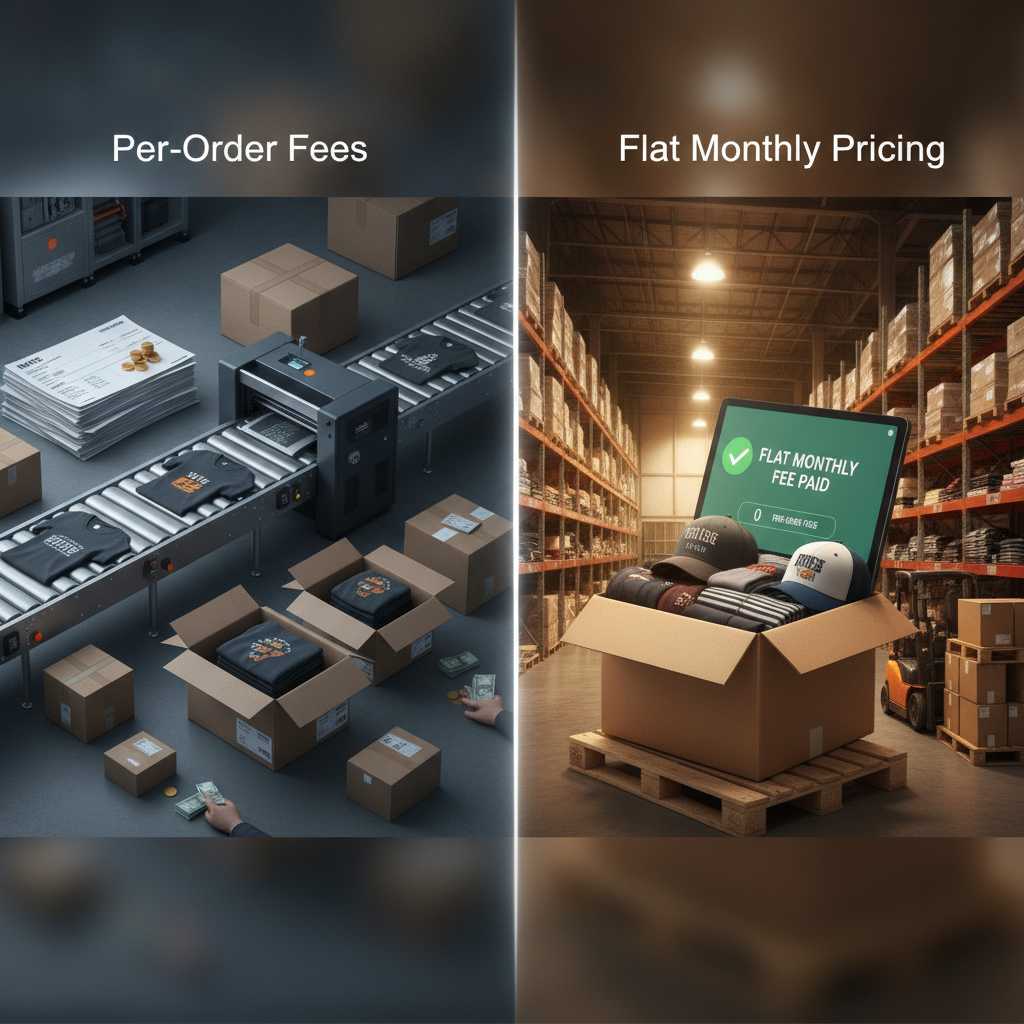
When you shop for fulfillment or order management software, you'll run into two very different ways of charging: per-order fees and flat monthly subscriptions. They can produce wildly different bills for the same business depending on how many orders you ship. The trick is knowing how to model your own numbers instead of guessing — and that's exactly what this guide walks through.
The two pricing models, explained plainly
A per-order fee model charges you a set amount (or a percentage) every time an order moves through the platform. Your software cost rises and falls directly with your order volume. Ship 100 orders, pay for 100. Ship 10,000, pay for 10,000.
A flat monthly subscription charges one predictable price each month regardless of how many orders you process. Whether you ship 500 orders or 50,000, the subscription line on your invoice stays the same.
Neither model is inherently better. Each one favors a different kind of business, and the right choice depends almost entirely on your volume and how fast it changes.
Where per-order pricing makes sense
Per-order fees are attractive when your volume is low or unpredictable. If you're just launching a print-on-demand store or testing a new sales channel, paying only when you actually sell something keeps your fixed costs near zero. There's no large monthly commitment hanging over a slow month.
The downside shows up as you grow. Because the fee applies to every single order, your software cost scales linearly — and sometimes faster than your margins do. A busy season that triples your orders also triples that line item, even though your underlying operation didn't get three times more expensive to run.
Where flat monthly pricing makes sense
A flat subscription rewards volume. Once you're shipping consistently, spreading one fixed price across thousands of orders drives your per-order software cost down with every additional order. The 5,000th order of the month effectively costs you nothing extra in software fees.
Flat pricing also makes forecasting easier. You know your software bill before the month starts, which simplifies budgeting and margin calculations on every product you list. The risk is on the low end: if your volume drops below a certain point, you're paying for capacity you aren't using.
How to calculate your break-even point
The goal is to find the order volume where the two models cost the same. Above that point, flat pricing wins; below it, per-order pricing wins. Here's the method:
- Step 1 — Find the flat monthly price. This is your fixed subscription cost for the plan you'd realistically use.
- Step 2 — Find the per-order cost. If it's a flat fee per order, that's your number. If it's a percentage, multiply your average order value by that percentage to get the dollar cost per order.
- Step 3 — Divide. Take the flat monthly price and divide it by the per-order cost. The result is your break-even order count.
For example, if a flat plan costs $300 per month and a competing per-order model charges $1.50 per order, your break-even is 200 orders ($300 ÷ $1.50). Ship more than 200 orders a month and the flat plan is cheaper. Ship fewer and the per-order model wins.
When the per-order charge is a percentage of revenue, the math is the same but the per-order figure moves with your average order value. A 5% fee on a $40 order is $2; on a $20 order it's $1. Run the calculation using your real average, and re-run it if your product mix or prices shift.
Don't forget the hidden variables
The clean break-even formula assumes everything else is equal. In practice, a few factors deserve attention:
- Seasonality. If your volume spikes around the holidays, per-order fees can balloon in exactly the months you're busiest. Model your peak month, not just your average.
- Order value mix. Percentage-based fees hit high-ticket orders harder. Flat-per-order fees hit low-ticket orders harder. Match the model to your typical basket.
- Growth trajectory. If you expect volume to climb, a flat plan that looks expensive today may be a bargain in six months. Project forward, not just where you are now.
- What's actually included. Compare scope, not just price. Order routing, inventory tracking, label generation, and analytics all have value that a bare per-order number can obscure.
How Pythias approaches pricing
Pythias Technologies uses a flat monthly subscription with no per-order fees on its Fulfillment Cloud, which is built for shops running their own production. That means your software cost stays the same whether you ship a hundred orders or tens of thousands in a given month. Fulfillment Cloud plans start at $199 per month, with Professional, Business, Scale, and Enterprise tiers above that.
For sellers who want orders auto-routed to vetted fulfillment partners, Commerce Cloud offers a Free tier ($0 plus a 15% margin fee) up through Scale ($799 plus 2%), with the margin fee never charged on a loss. That structure lets you start with no fixed cost and graduate to lower percentage tiers as volume grows.
On either path, orders from 18+ marketplaces and 200+ channels — Amazon, Walmart, Etsy, TikTok Shop, Shopify and more — flow into one unified production queue, with dedicated routing for DTF, DTG, embroidery, and sublimation, carrier label generation, real-time inventory by blank, color, and size, and tracking confirmed back to each marketplace automatically. You can see the full breakdown on the pricing page and run your own break-even math against your real volume.
Most shops are fully live within about two weeks. If you'd like to walk through which model fits your numbers, book a demo and bring your monthly order counts.