
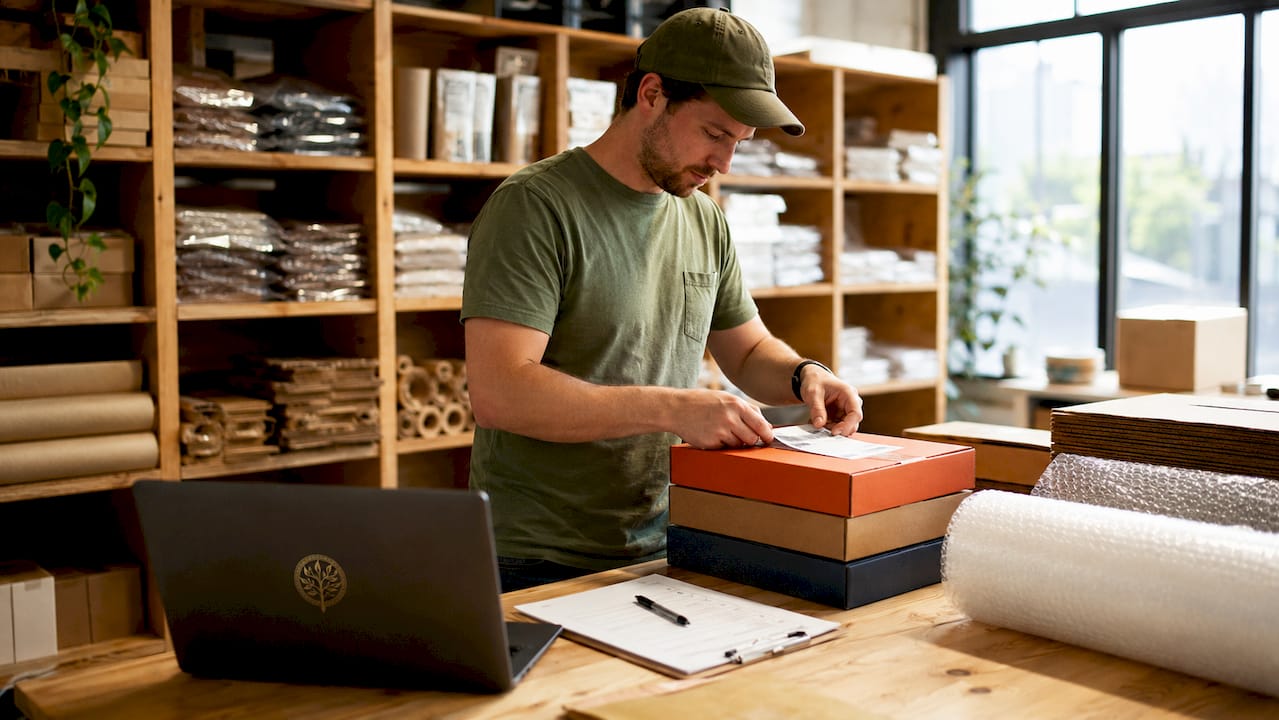
Fulfillment is defined as the complete post-production process of receiving orders, managing inventory, packing, and shipping printed products to customers, while a print shop is the production stage that creates the physical items. Understanding what is fulfillment versus print shop is the operational foundation every print-on-demand business owner needs before making decisions about vendors, workflows, or technology. These two functions are often confused or bundled together, but they represent distinct stages in the order lifecycle. Platforms like Shopify, Amazon, and Etsy have accelerated the growth of print-on-demand services, making it more critical than ever to know exactly where printing ends and fulfillment begins. Misreading that boundary costs money, delays orders, and creates gaps in customer experience.
What does fulfillment encompass compared to a traditional print shop?
Printing ends at the loading dock; fulfillment begins the moment a customer places an order and covers everything from storage to final delivery. A traditional print shop produces physical copies of a product, whether that is a T-shirt, a book, or a poster, and its responsibility typically stops when the finished goods leave the press. Fulfillment picks up from there and manages a separate, equally complex set of operations.
Fulfillment in print includes order processing, quality control, packaging, shipping, delivery tracking, and customer communication. Each of these steps requires dedicated resources, software, and trained staff. A print shop that assumes it is also handling fulfillment by dropping boxes at a carrier dock is missing the majority of what fulfillment actually involves.
The key operational components of a fulfillment operation include:
- Inventory receiving and storage: Warehousing printed goods by SKU, tracking quantities, and managing reorder thresholds
- Order management: Processing incoming orders from ecommerce channels and routing them to the correct pick location
- Picking and packing: Selecting the correct items, applying custom packaging or inserts, and preparing shipments
- Carrier handoff and tracking: Generating shipping labels, selecting carriers, and providing tracking updates to customers
- Returns processing: Receiving, inspecting, and restocking or disposing of returned items
Ecommerce fulfillment covers all of these functions, either managed in-house or outsourced to a third-party logistics provider (3PL). The decision between in-house and outsourced fulfillment depends on order volume, warehouse capacity, and how much operational control you want to retain.
Pro Tip: Map your current workflow and mark exactly where your print shop’s responsibility ends. If you cannot identify a clear handoff point, you likely have a fulfillment gap that is creating hidden costs or customer service issues.
How do print-on-demand fulfillment services differ from traditional print shops?
Print-on-demand fulfillment produces and ships products only after an order is received, which eliminates pre-printed inventory entirely. This is the defining structural difference between POD fulfillment and a traditional print shop model. Traditional print shops rely on forecasts and batch printing, which means goods are produced in advance and stored until orders arrive. That model creates inventory risk, ties up cash, and limits SKU scalability.

POD fulfillment routes each order to the nearest production facility, prints the item, finishes it, and ships it directly to the customer. This direct-to-customer flow removes the warehousing layer that traditional print shops depend on. For businesses selling across Amazon, Etsy, and Shopify simultaneously, POD fulfillment also means you can offer hundreds of SKUs without holding a single unit of stock.
| Factor | Traditional print shop | POD fulfillment |
|---|---|---|
| Production trigger | Forecast or batch order | Individual customer order |
| Inventory requirement | Pre-printed stock held in warehouse | No pre-printed inventory |
| Cash flow impact | Capital tied up in stock | Payment received before production |
| SKU scalability | Limited by storage and print runs | Scales without inventory cost |
| Shipping model | Bulk to distributor or retailer | Direct to end customer |
| Risk profile | Overstock and obsolescence risk | Near-zero inventory risk |
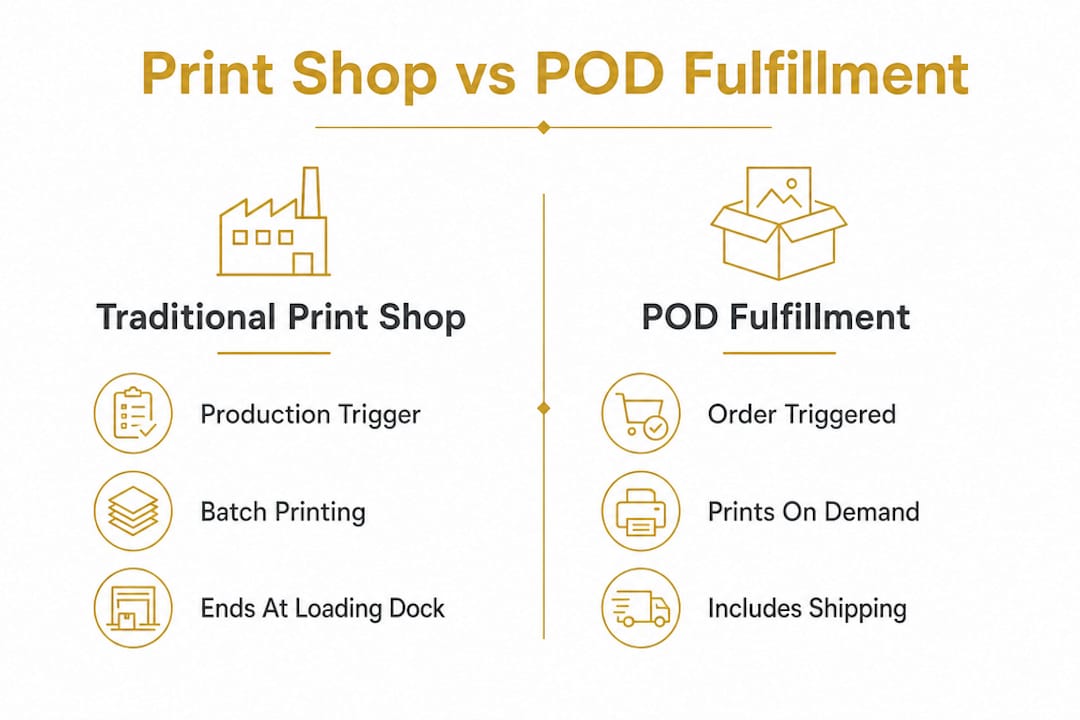
The cash flow difference alone is significant for growing businesses. With traditional batch printing, you pay for production before you know demand. With POD fulfillment, production cost is triggered by a confirmed sale. For businesses exploring top POD products across multiple categories, this model removes the financial barrier to testing new designs or product lines.
Pro Tip: If you are running a traditional print shop and want to add POD capabilities, start with one product category and one marketplace. Validate the workflow before scaling across all channels.
What operational challenges arise from mixing or separating print and fulfillment services?
Combining printing and fulfillment under one roof works well for small-scale or POD operations, but separating them gives larger businesses more control, cost savings, and branding flexibility. The challenge is knowing when each model fits your operation. Here are the most common operational issues that arise when the boundary between print and fulfillment is not clearly defined:
- Quality control location ambiguity. When printing and fulfillment are handled by different vendors, it is unclear who inspects the product before it ships. Contracts must specify whether QC happens at the print facility, the fulfillment center, or both.
- Packaging and branding gaps. Print shops produce the item; fulfillment centers pack and ship it. If your fulfillment provider does not support custom packaging, branded inserts, or specific box sizes, the customer experience suffers regardless of print quality.
- Bulk order logistics complexity. Large orders destined for retail distribution require palletizing, freight coordination, and compliance labeling. Most print shops do not handle freight logistics, and many fulfillment centers charge separately for these services.
- International shipping coordination. Cross-border shipments require customs documentation, harmonized tariff codes, and carrier selection by destination country. Neither a print shop nor a basic fulfillment center automatically handles all of this without explicit service agreements.
- Automation gaps between systems. When your print shop uses one software platform and your fulfillment center uses another, order data must be transferred manually or through custom integrations. This creates errors, delays, and reporting blind spots.
Fulfillment contracts in print businesses need explicit clarity on quality control location, inventory management across facilities, and returns processing. Without that clarity, gaps in accountability appear exactly when order volumes spike, which is the worst possible time to discover them.
What factors should you consider when choosing between fulfillment and a print shop?
Choosing a fulfillment setup depends on business size, product type, order volume, and brand priorities. These four variables determine whether you need a dedicated fulfillment partner, an integrated POD platform, or a traditional print shop with in-house logistics. Use the following criteria to assess your situation:
- Order volume and frequency: Low-volume operations with fewer than 50 orders per day can often manage fulfillment in-house. Above that threshold, outsourcing to a 3PL or using an integrated POD platform typically reduces per-order cost and error rates.
- Branding and packaging requirements: If your brand depends on custom unboxing experiences, branded tissue paper, or personalized inserts, verify that your fulfillment provider supports these before signing a contract. Many standard fulfillment centers do not.
- Inventory risk tolerance: Businesses with seasonal demand or frequently changing designs should favor POD fulfillment to avoid overstock. Businesses with stable, high-volume SKUs may find batch printing more cost-effective per unit.
- Technology integration needs: Your fulfillment setup must connect to your ecommerce channels. A provider that does not integrate with Shopify, Amazon, or Etsy will require manual order entry, which does not scale. Review POD integration types before committing to any platform.
- Scalability and customer experience: Fulfillment speed directly affects customer satisfaction scores and marketplace rankings. A fulfillment center with multiple warehouse locations can reduce transit times by routing orders to the facility closest to the customer.
The print shop vs fulfillment decision is not permanent. Many businesses start with a combined model and separate the functions as they grow. What matters is that you make the decision deliberately, based on data, not by default.
How automation technology supports fulfillment and print shop operations
Technology platforms that automate order routing, inventory updates, and shipping reduce errors and accelerate fulfillment workflows in both print shops and third-party fulfillment centers. Cloud-based print management solutions now connect production equipment, inventory systems, and ecommerce channels in a single interface. This removes the manual data transfer that creates most fulfillment errors.
The operational benefits of automation in print-on-demand fulfillment include:
- Real-time inventory tracking: Automatic SKU updates across all sales channels prevent overselling and reduce customer service contacts related to out-of-stock items
- Automated label generation: Shipping labels are created at the moment an order is confirmed, eliminating manual entry and carrier selection errors
- Order routing by production capacity: Orders are assigned to the print facility with available capacity and the shortest distance to the customer, reducing both production time and shipping cost
- Production reporting and alerts: Managers receive queue status reports, bottleneck alerts, and completion notifications without checking multiple systems manually
- Marketplace integration: Orders from Amazon, Etsy, and Shopify flow into a single production queue, with status updates pushed back to each platform automatically
Platforms like Pythias Technologies connect directly to Brother GTX printers and other major production equipment, which means the order data flows from the marketplace to the press without manual intervention. For DTG printing operations, this level of integration is the difference between processing 50 orders per day and processing 500.
Pro Tip: Before evaluating any automation platform, audit your current order error rate and average fulfillment time. These two numbers are your baseline. Any platform you adopt should show measurable improvement in both within 90 days.
Key takeaways
Fulfillment and print shop operations are distinct functions that require separate planning, contracts, and technology to execute without gaps.
| Point | Details |
|---|---|
| Print shop scope | Printing ends at production; fulfillment covers inventory, packing, shipping, and returns. |
| POD fulfillment advantage | Producing only after an order is received eliminates inventory risk and frees up cash flow. |
| Contract clarity | Fulfillment agreements must specify QC location, returns handling, and inventory responsibility. |
| Decision criteria | Order volume, branding needs, and technology integration determine the right fulfillment model. |
| Automation impact | Platforms connecting print equipment to ecommerce channels reduce errors and cut fulfillment time. |
Where the real operational risk lives
Most print business owners I have worked with underestimate fulfillment scope. They think of it as “the shipping part” and treat it as a commodity. That framing is the source of most operational failures I see.
Focusing solely on shipping labels under-scopes fulfillment complexity and leads directly to customer experience failures. The businesses that get this right are the ones that treat fulfillment as a system, not a task. They define service boundaries in writing before a vendor relationship starts. They audit quality control checkpoints. They test returns workflows before they have a problem, not after.
The other mistake I see consistently is assuming that a POD platform automatically solves fulfillment. It does not. A platform automates the data flow, but you still need to define who owns quality, who handles damaged shipments, and what happens when a carrier loses a package. Technology accelerates the process; it does not replace the operational decisions.
My honest recommendation: if you are running more than 100 orders per week and you cannot describe your fulfillment workflow in five steps or fewer, you have a process problem that technology alone will not fix. Start with capacity planning before you invest in automation. Know your constraints before you try to remove them.
— Michael
How Pythias Technologies connects print production to fulfillment
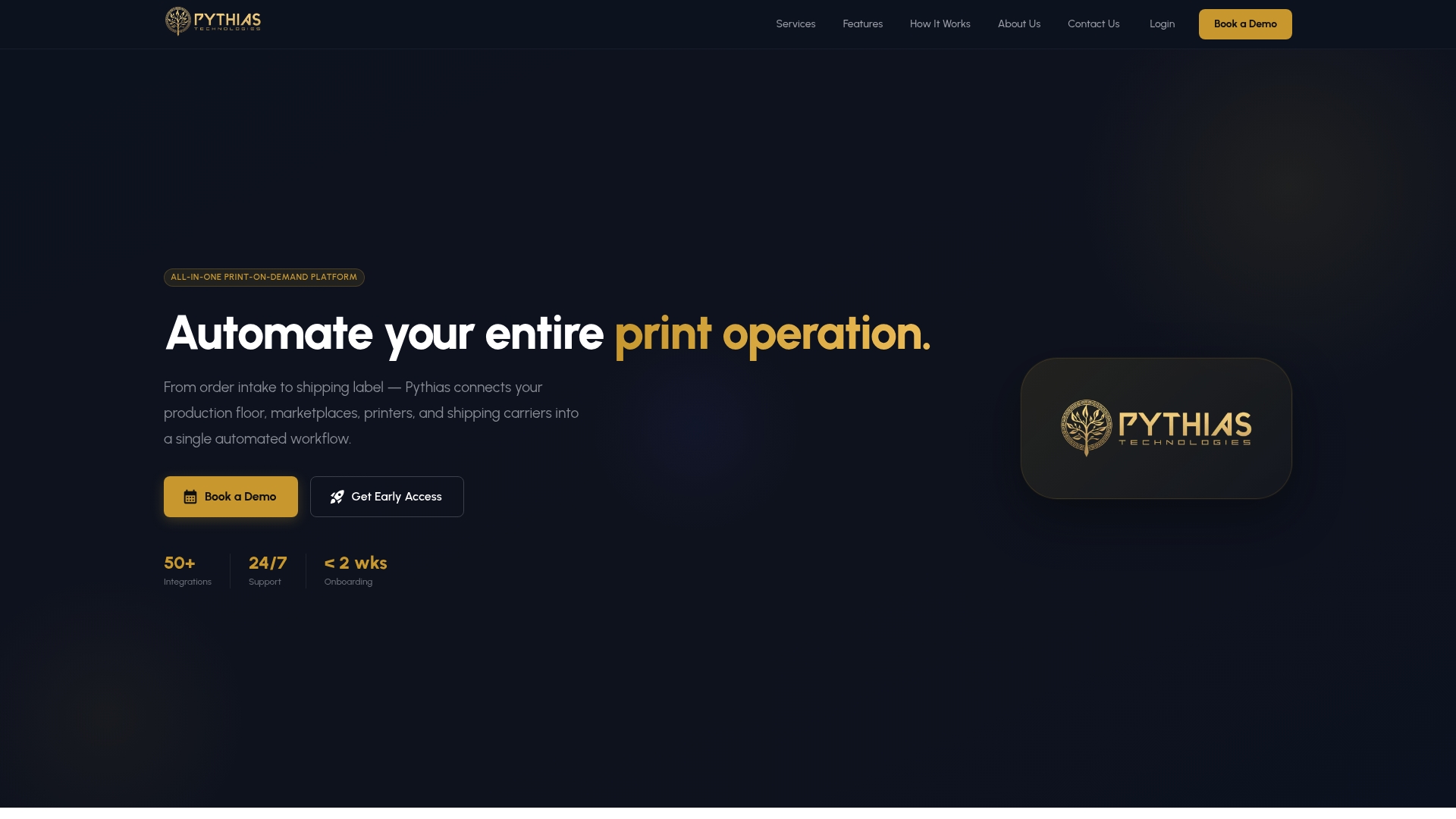
Pythias Technologies is a print-on-demand automation platform built specifically for businesses that need production and fulfillment to operate as one connected system. The platform integrates with Amazon, Etsy, and Shopify, routing orders directly into your production queue and generating shipping labels automatically. Real-time inventory management keeps stock levels accurate across all channels, and the multi-marketplace integration eliminates manual order entry entirely. Pythias helps shops automate production and fulfillment so they can grow revenue and ship faster. Onboarding takes under two weeks. Visit Pythias Technologies to book a demo and see how the platform fits your operation.
FAQ
What is the difference between a print shop and fulfillment?
A print shop produces physical printed items and its responsibility ends at production. Fulfillment covers everything after production, including inventory storage, order processing, packing, shipping, and returns handling.
Does a print shop handle shipping?
Most print shops do not include fulfillment services; printing ends at production and requires separate logistics arrangements. Businesses that assume printing includes shipping often discover operational gaps when order volumes increase.
What is print-on-demand fulfillment?
Print-on-demand fulfillment produces and ships a product only after a customer order is received, routing that order to the nearest production facility and shipping directly to the customer. This model eliminates pre-printed inventory and the cash flow risk that comes with it.
What does a 3PL do in a print fulfillment context?
A 3PL provider receives your printed inventory, stores it, and executes picking, packing, shipping, and returns on your behalf. In a POD model, the 3PL may also manage the production trigger, connecting order receipt directly to print production.
How do I choose between in-house fulfillment and outsourcing?
The decision depends on order volume, branding requirements, and technology integration capacity. Businesses processing fewer than 50 orders per day can often manage fulfillment in-house, while higher volumes and fulfillment center features like multi-location warehousing typically justify outsourcing.
Recommended
- Print on Demand Products: Top 10 for Entrepreneurs | Pythias Technologies | Pythias Technologies
- Types of Print on Demand Integrations for Entrepreneurs | Pythias Technologies
- Print Shop Capacity Planning: What Managers Must Know | Pythias Technologies
- DTG Printing Order Management for Print Shops in 2026 | Pythias Technologies | Pythias Technologies