
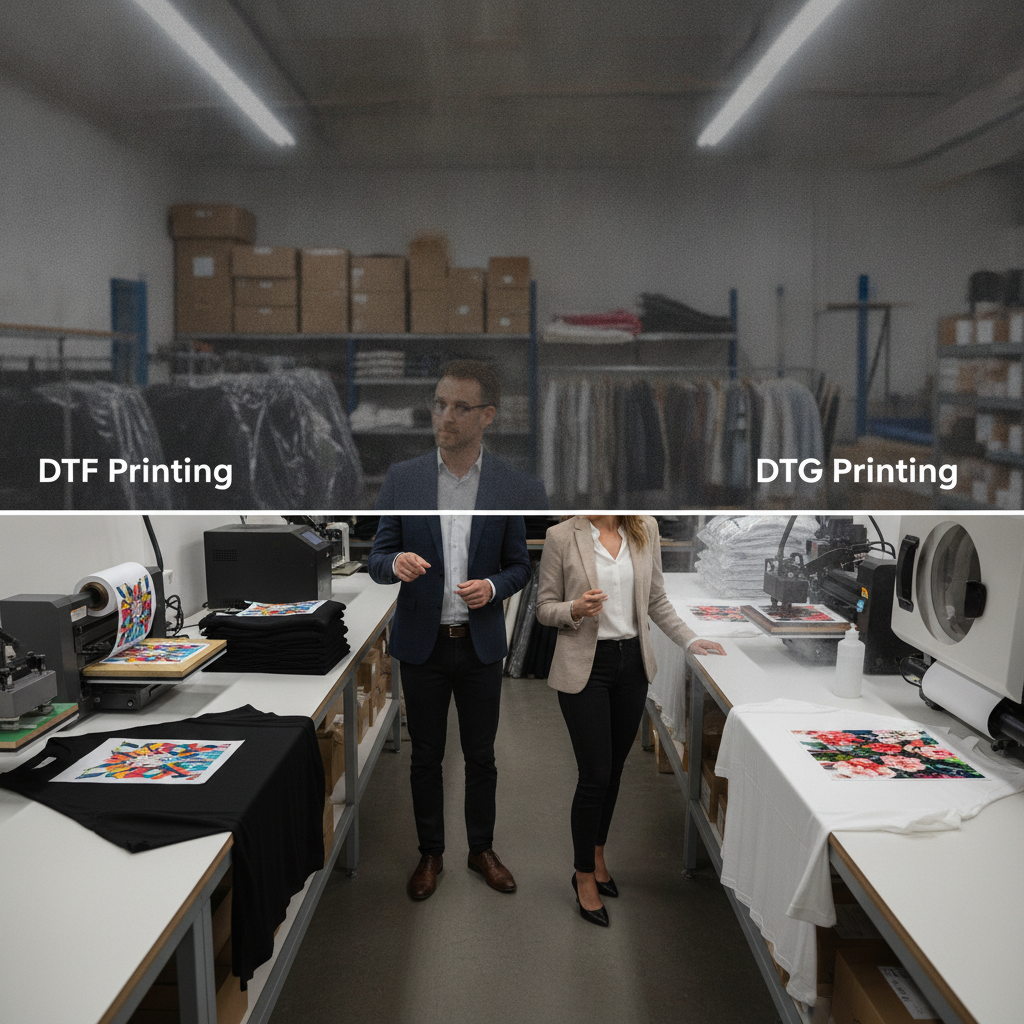
If you run an apparel print shop or sell custom garments, two methods dominate the conversation right now: direct-to-film (DTF) and direct-to-garment (DTG). Both produce full-color prints without screens, both suit short runs and one-offs, and both can fit neatly into a print-on-demand workflow. But they behave differently on the press, on the fabric, and on your cost sheet. This guide compares them across the four factors that actually decide which one belongs in your shop.
How DTF and DTG actually work
DTG prints water-based ink directly onto the garment, much like an inkjet printer lays ink onto paper. The ink soaks into the fabric fibers, which is why the print feels soft and integrated with the shirt. A pretreatment step is required before printing — especially on dark garments — to help the ink bond and stay vivid.
DTF prints the design onto a special film, then applies a powder adhesive that is cured and heat-pressed onto the garment. Because the image sits on a transferable film layer, it bonds to the surface rather than soaking into the fibers. That single difference drives most of the trade-offs below.
Fabric compatibility
This is often the deciding factor.
DTG performs best on 100% cotton and high-cotton blends. The ink needs natural fibers to absorb into, so cotton-rich garments give the brightest, most durable results. Polyester and heavily synthetic fabrics tend to produce weaker color and adhesion with DTG, which limits the range of blanks you can confidently print.
DTF is far more forgiving. Because the design bonds to the surface, it adheres well to cotton, polyester, blends, nylon, and many performance fabrics. If you want to print on a wide variety of blanks — tote bags, athletic wear, hoodies, hats, and tees — DTF gives you flexibility that DTG can't match.
- Choose DTG when your catalog is mostly cotton apparel and a soft, in-the-fabric feel matters.
- Choose DTF when you need to print across mixed materials without re-tooling your process for each one.
Durability and feel
Both methods can hold up well through repeated washing when done correctly, but they age differently.
DTG prints feel soft because the ink is part of the fabric. Over many wash cycles, prints can gradually fade, which some customers actually prefer for a vintage look. Proper pretreatment and curing are essential — skipping or rushing them is the most common cause of premature fading.
DTF prints sit on top of the fabric, so they tend to resist cracking and fading well and hold bold, saturated color. The trade-off is hand feel: the transfer can feel slightly heavier or have a faint film edge, especially on large designs. Many shops mitigate this with hot/cold peel techniques and quality films, but it's a real consideration for soft-feel brands.
Cost considerations
We won't quote specific figures here because equipment, ink, and blank prices vary widely by region and supplier. Instead, focus on the cost structure of each method.
DTG typically involves a higher equipment investment and ongoing pretreatment and ink costs. Per-print cost is heavily influenced by ink coverage and garment color — dark garments use more ink and require pretreatment, which raises the cost per piece.
DTF generally has a lower barrier to entry on equipment and lets you gang multiple designs onto a single sheet of film, which can improve material efficiency for varied orders. You can also print transfers ahead of time and press them on demand, which decouples printing from pressing.
Whichever path you choose, your real margin depends as much on operations as on the press. Wasted blanks, misrouted orders, and manual data entry quietly erode profit. A solid order management system and accurate inventory tracking often matter more to the bottom line than the per-print difference between two methods.
Ideal use cases
Here's how the two tend to shake out by product and order profile:
- Soft cotton tees and premium streetwear — DTG, for the integrated feel and photorealistic detail on cotton.
- Mixed catalogs across many fabric types — DTF, for broad compatibility on one process.
- Performance and athletic wear — DTF, since synthetics resist DTG ink.
- Bold, high-opacity logos and graphics — DTF, for saturated color that resists cracking.
- Photographic art on cotton — DTG, for smooth gradients and a natural finish.
Plenty of shops run both. DTG covers the cotton apparel that wants a soft feel, while DTF handles everything else and absorbs overflow during busy periods.
Running DTF and DTG together without the chaos
Offering two print methods is great for your catalog, but it doubles the operational complexity if you manage it by hand — different print-ready files, different routing rules, different production steps. This is where your software stack earns its keep.
Pythias Technologies is an all-in-one print-on-demand and multichannel fulfillment platform built for exactly this situation. Pythias has dedicated production queues for DTF, DTG, embroidery, and sublimation, each with its own routing rules and print-ready file handling, so a DTF order and a DTG order don't get tangled on the same workflow.
Orders from every connected channel flow into one unified production queue, and Pythias connects directly to 18+ marketplaces — including Amazon, Walmart, Etsy, TikTok Shop, and Shopify — plus 200+ more through Mirakl and Acenda. It generates carrier shipping labels for USPS, FedEx, and UPS, confirms tracking back to each marketplace automatically, and tracks real-time inventory by blank, color, and size with low-stock and reorder alerts. If you run your own production, Fulfillment Cloud starts at $199/month with no per-order fees — it's a flat monthly subscription. If you'd rather route orders to vetted partners, Commerce Cloud scores each order by geography, price, and reliability and sends it to the best fit.
Most shops are fully live on Pythias within about two weeks. If you're deciding which methods to offer and want the operations to scale with you, book a demo or compare the pricing tiers to see what fits.